

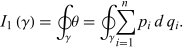
The Poincaré integral invariant of a closed curve  in the phase space of a Hamiltonian
system is the integral of the canonical one-form
in the phase space of a Hamiltonian
system is the integral of the canonical one-form  ,
,
 |
(1)
|
If  is the phase flow generated by the Hamiltonian, then
 |
(2)
|
Thus the integral is unchanged when every point of  is transported by the phase flow (Arnold 1989, pp. 237-239).
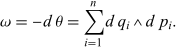
The corresponding symplectic form is
 |
(3)
|
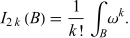
Since the phase flow preserves  , it also preserves its exterior
powers. For
, it also preserves its exterior
powers. For  and a transported
  -dimensional region
  ,
the absolute integral invariants are therefore
,
the absolute integral invariants are therefore
 |
(4)
|
For  ,
this is the sum of the signed areas of the projections
of
,
this is the sum of the signed areas of the projections
of  onto the coordinate planes
  . For
. For  , it is the phase space volume
 |
(5)
|
whose invariance is Liouville's phase space theorem.
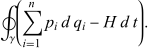
On extended phase space, the Poincaré-Cartan integral invariant includes the Hamiltonian,
 |
(6)
|
It is unchanged when  is transported by the corresponding phase
flow.
is transported by the corresponding phase
flow.
