

A state transition matrix describes the linearized dependence of a dynamical system's state at one time on its state at another time. For the system
 |
(1)
|
let  denote the solution satisfying
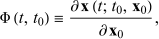
  . The state transition matrix is the Jacobian
 |
(2)
|
and maps an infinitesimal perturbation according to
 |
(3)
|
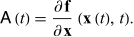
Along the reference solution, define the Jacobian
 |
(4)
|
Then  satisfies the initial value problem
 |  |  |
(5)
|
 |  |  |
(6)
|
where  is the identity matrix. It also satisfies
 |  |  |
(7)
|
 |  |  |
(8)
|
 |  |  |
(9)
|
The last identity is the composition law.
For the linear time-invariant system  ,
,
![Phi(t,t_0)=exp[A(t-t_0)],](/images/equations/StateTransitionMatrix/NumberedEquation5.svg) |
(10)
|
so the state transition matrix is a matrix exponential. For a Hamiltonian system written in canonical position and momentum coordinates,
 |
(11)
|
where  represents the canonical symplectic form. Thus
 belongs to the symplectic group and has determinant
1.
belongs to the symplectic group and has determinant
1.
State transition matrices can be computed by integrating the initial value problem above or approximated with finite differences (Pellegrini and Russell 2016).
