

A physical measure is an invariant measure whose long-term statistical averages describe a set of initial
points of positive reference volume. More precisely, let
 be a continuous
map of a compact metric space with a specified
finite reference Borel measure
 . An invariant Borel measure
 that is a probability
measure is physical relative to
 if the set of points
 satisfying
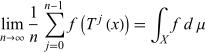 |
for every continuous function  has positive
 -measure (Young 2002). The usual
reference is ambient Lebesgue measure, or volume
coming from a Riemannian metric. The reference
measure is part of the definition.
The reference measure matters: a set of full  -measure can have zero
 -measure. On a compact interval,
an ergodic measure with a probability
density function relative to Lebesgue measure
is physical. Indeed, apply Birkhoff's ergodic
theorem to a countable set of continuous
functions that is dense in the uniform norm.
Uniform approximation extends convergence to every continuous
function on a common set of full
 -measure. This set
must have positive Lebesgue measure. A physical
measure need not have a probability density
function.
