

Birkhoff's ergodic theorem states that if  is an ergodic measure-preserving endomorphism
of a probability space
is an ergodic measure-preserving endomorphism
of a probability space  and
and  is an integrable real-valued measurable
function, then for almost every
is an integrable real-valued measurable
function, then for almost every  , we have
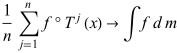 |
(1)
|
as  .
To illustrate this, take
.
To illustrate this, take  to be the characteristic
function of some measurable subset
to be the characteristic
function of some measurable subset  of
of  so that
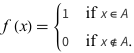 |
(2)
|
The left-hand side of the first displayed equation just says how often the map orbit of  (that is, the points
  ,
,  ,
,  , ...) lies in
  , and the right-hand side is just the measure
of
, and the right-hand side is just the measure
of  .
Thus, for an ergodic endomorphism, "space-averages
= time-averages almost everywhere." Moreover,
if
.
Thus, for an ergodic endomorphism, "space-averages
= time-averages almost everywhere." Moreover,
if  is a continuous map on a compact
space and is uniquely ergodic with Borel measure
is a continuous map on a compact
space and is uniquely ergodic with Borel measure  and
and  is a continuous function, then we can replace
the almost everywhere convergence in the first
displayed equation with "everywhere."
is a continuous function, then we can replace
the almost everywhere convergence in the first
displayed equation with "everywhere."
