TOPICS
Search

Overlapping Circles Grid


OverlappingCirclesGrid

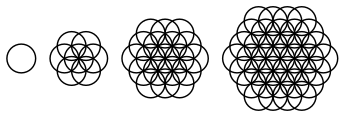
An overlapping circles grid is an arrangement of congruent circles with centers on a lattice and radii large enough that neighboring circles overlap. In the common triangular form, the centers lie on a triangular lattice and each radius equals the nearest-neighbor distance.

The number of circles in a patch consisting of a central circle and successive complete hexagonal rings is the centered hexagonal number, also called a hex number,

 a_n=3n(n-1)+1,

which for n=1, 2, ... gives 1, 7, 19, 37, ... (OEIS A003215). The pattern can be continued indefinitely.

Such triangular grids occur in decorative art from antiquity through the medieval and Renaissance periods (Wolfram 2002, pp. 43 and 873; Katz and Jin 2016).

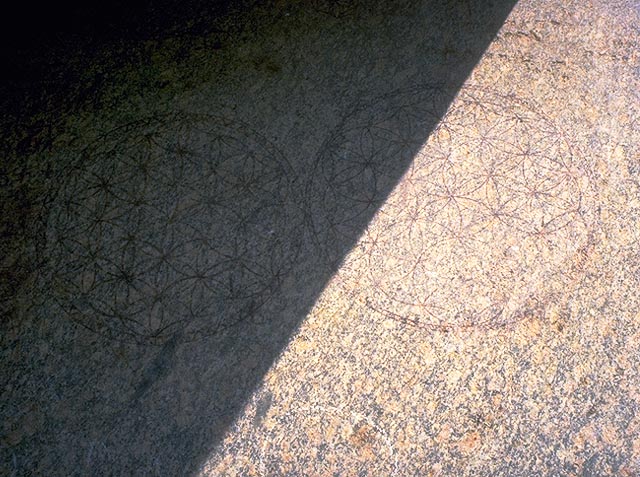
A pattern resembling an overlapping circles grid at the Osireion at Abydos, Egypt.

A related pattern occurs at the Osireion at Abydos, Egypt (Rawles 1997).

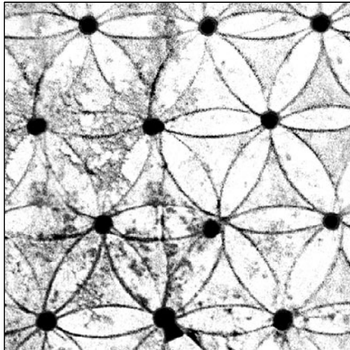
A triangular overlapping circles grid on a Phoenician ivory carving from about 900 BC.

The Phoenician ivory carving bears a triangular grid of overlapping circles. It dates from about 900 BC, is presumably from the Mediterranean area, and is now in the British Museum (Wolfram 2002, pp. 43 and 873).

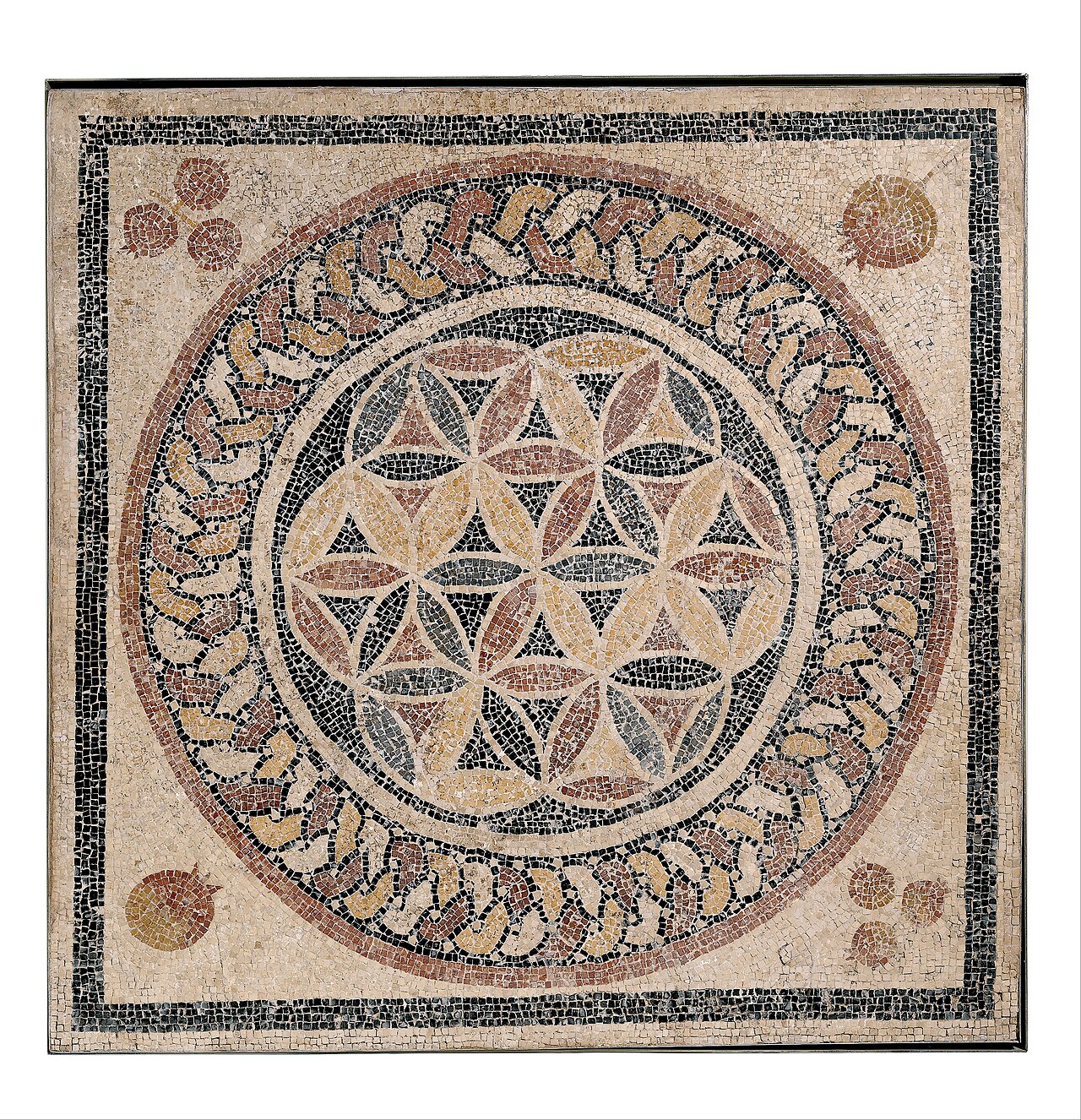
A first-century BC mosaic floor from a bathhouse in Herod's palace.

A seven-circle overlapping pattern occurs in a first-century BC floor mosaic from a bathhouse in Herod's palace (Katz and Jin 2016).

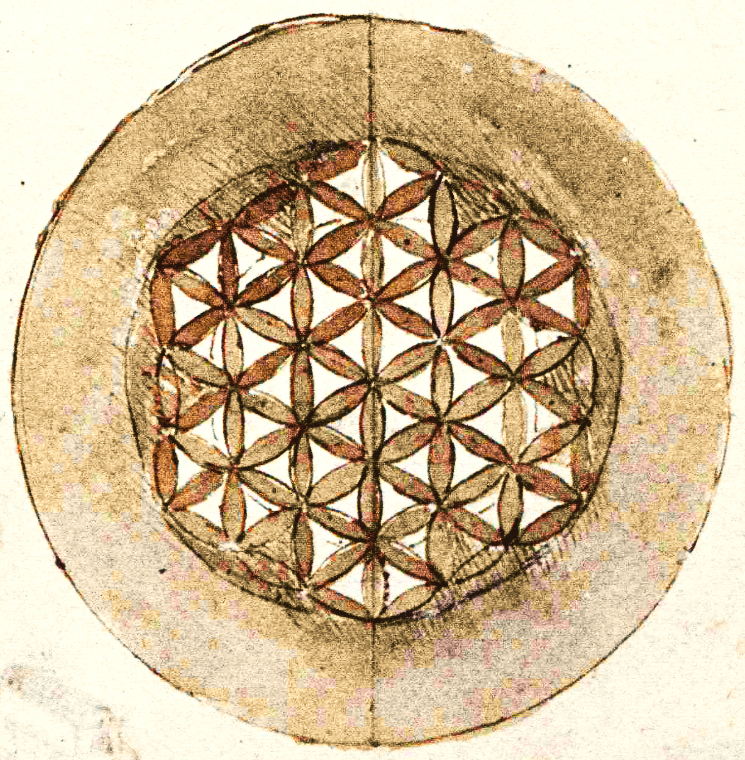
A circle construction by Leonardo da Vinci in Codex Atlanticus, folio 309v (1478--1519).

A related circle geometric construction appears in Leonardo da Vinci's Codex Atlanticus, folio 309v (Leonardo da Vinci 1478-1519).

Modern usage calls the seven-circle patch the seed of life and the 19-circle patch the flower of life. A different 13-circle selection is called the fruit of life; joining its circle centers by line segments gives Metatron's cube (Melchizedek 1999, pp. 42-43 and 158-160).


See also

Circle Packing, Flower of Life, Fruit of Life, Hex Number, Hexagonal Lattice, Metatron's Cube, Seed of Life, Triangular Lattice, Vesica Piscis

Explore with Wolfram|Alpha

References

Flowers, R. "Ornament Resembling the Flower of Life at the Osireion at Abydos, Egypt." Photograph, 2006. CC BY-SA 3.0 via Wikimedia Commons. https://commons.wikimedia.org/wiki/File:Temple-of-Osiris_Flower-of-Life_02.jpg.Israel Museum. "Mosaic Floor from a Bathhouse in Herod's Palace." Herodian period, 1st century BC, accession no. 829245. Public-domain image via Wikimedia Commons. https://commons.wikimedia.org/wiki/File:Mosaic_floor_from_a_bathhouse_in_Herod%27s_palace_-_Google_Art_Project.jpg.Katz, E. A. and Jin, B.-Y. "Fullerenes, Polyhedra, and Chinese Guardian Lions." Math. Intelligencer 38, 61-68, 2016. https://doi.org/10.1007/s00283-016-9663-0.Leonardo da Vinci. "Codex Atlanticus, Folio 309v." Detail image, 1478-1519. Public-domain reproduction via Wikimedia Commons. https://commons.wikimedia.org/wiki/File:Leonardo_da_Vinci_-_Codex_Atlanticus_folio_309v_detail1.png.Melchizedek, D. The Ancient Secret of the Flower of Life, Volume One. Flagstaff, AZ: Light Technology Publishing, pp. 42-43 and 158-160, 1999.Rawles, B. Sacred Geometry Design Sourcebook: Universal Dimensional Patterns. Nevada City, CA: Elysian Pub., p. 15, 1997.Sloane, N. J. A. Sequence A003215 in "The On-Line Encyclopedia of Integer Sequences."Wolfram, S. A New Kind of Science. Champaign, IL: Wolfram Media, pp. 43 and 873, 2002.

Cite this as:

Weisstein, Eric W. "Overlapping Circles Grid." From MathWorld--A Wolfram Resource. https://mathworld.wolfram.com/OverlappingCirclesGrid.html

Subject classifications