

The ordered Bell number  , also called the Fubini number,
counts the lists of disjoint nonempty subsets whose union is a fixed
 -element set. Here
 is a nonnegative integer,
and
 counts the empty list. Unlike the Bell
numbers, these numbers distinguish different orders of the blocks.
For  , 1, ..., the first values are 1, 1, 3, 13, 75, 541,
4683, 47293, ... (OEIS A000670). A set
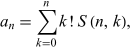
partition with
 blocks has
 possible block orders, giving
 |
(1)
|
where  is a Stirling number of the second
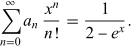
kind. As an identity of formal power series,
and analytically for
 , the exponential
generating function is
 |
(2)
|
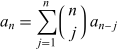
Choosing the first nonempty block gives the recurrence relation
 |
(3)
|
for  , where
 is a binomial coefficient.
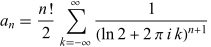
The exponential generating function, regarded as a meromorphic function, has simple poles at  for integer
 , each with complex residue
 . Applying the residue
theorem gives the absolutely convergent
representation
 |
(4)
|
for  , where
 is the imaginary unit. The
nearest pole to the origin is
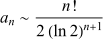
 . Its contribution gives
 |
(5)
|
as  (Wilf 1994, pp. 175-176). This explains why the leading approximation gives
almost integers for small positive
integers
 .
These numbers count the button codes in the combination lock model, where each block consists of the buttons pressed simultaneously and the block order specifies the sequence of presses (Velleman and Call 1995).
