


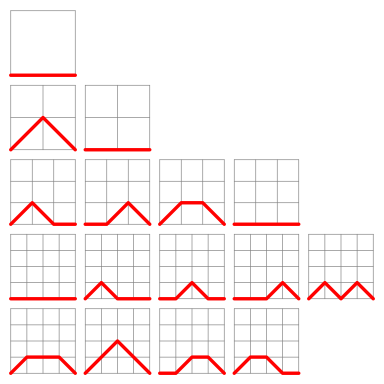
The Motzkin numbers enumerate various combinatorial objects. Donaghey and Shapiro (1977) give 14 different manifestations of these numbers. In particular, they give
the number of paths from (0, 0) to ( , 0) which never dip below
  and are made up only of the steps (1, 0), (1, 1), and (1,
 ), i.e.,
  ,
,  , and
, and  .
.
The first are 1, 2, 4, 9, 21, 51, ... (OEIS A001006). The numbers of decimal digits in  for
for  , 1, ... are 1, 4, 45, 473, 4766, 47705, 477113, ... (OEIS
A114473), where the digits approach those of
, 1, ... are 1, 4, 45, 473, 4766, 47705, 477113, ... (OEIS
A114473), where the digits approach those of
 (OEIS A114490).
The first few prime Motzkin numbers are 2, 127, 15511, 953467954114363, ... (OEIS A092832), which correspond to indices 2, 7,
12, 36, ... (OEIS A092831), with no others
for  (Weisstein, Mar. 29, 2005).
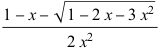
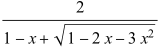
The Motzkin number generating function  satisfies
 |
(1)
|
and is given by
 |  |  |
(2)
|
 |  |  |
(3)
|
 |  |  |
(4)
|
If  is the
  th
Riordan number, then
th
Riordan number, then
 |
(5)
|
(Bernhart 1999).
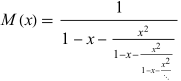
 therefore is given by the continued
fraction
therefore is given by the continued
fraction
 |
(6)
|
(M. Somos, pers. comm., Apr. 15, 2006).
They are given by the recurrence relation
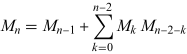 |
(7)
|
with  ,
as well as the nested recurrence
,
as well as the nested recurrence
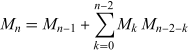 |
(8)
|
with  .
.
The Motzkin number  is also given by
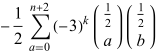 |  |  |
(9)
|
 |  |  |
(10)
|
 |  |  |
(11)
|
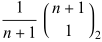 |  |  |
(12)
|
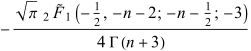 |  |  |
(13)
|
 |  | ![(i^n3^(n/2))/2[3P_n(-1/3isqrt(3))+2isqrt(3)P_(n+1)(-1/3isqrt(3))+3P_(n+2)(-1/3isqrt(3))],](/images/equations/MotzkinNumber/Inline44.svg) |
(14)
|
where  ,
,
 is a binomial
coefficient,
is a binomial
coefficient,  is a trinomial coefficient,
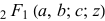
  is a hypergeometric
function,
is a hypergeometric
function,  is a regularized hypergeometric
function,
is a regularized hypergeometric
function,  is a gamma function, and
  is a Legendre polynomial.
