


The Delannoy numbers  are the number of lattice paths from
  to
to  in which only east (1, 0), north (0, 1), and northeast
(1, 1) steps are allowed (i.e.,
in which only east (1, 0), north (0, 1), and northeast
(1, 1) steps are allowed (i.e.,  ,
,  , and
, and  ). They are given by the recurrence
relation
). They are given by the recurrence
relation
 |
(1)
|
with  .
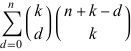
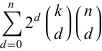
They are also given by the sums
.
They are also given by the sums
 |  |  |
(2)
|
 |  |  |
(3)
|
 |  |  |
(4)
|
where 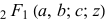 is a hypergeometric function.
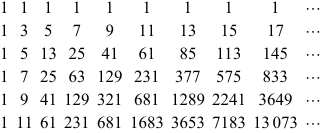
A table for values for the Delannoy numbers is given by
 |
(5)
|
(OEIS A008288) for  , 1, ... increasing from left to right and
  , 1, ... increasing from top to bottom.
They have the generating function
 |
(6)
|
(Comtet 1974, p. 81).
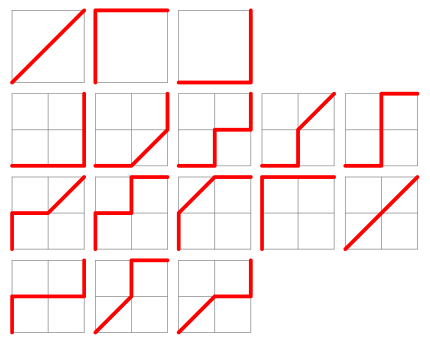
Taking  gives the central Delannoy numbers
  , which are the number of "king walks" from
the
, which are the number of "king walks" from
the  corner of an
  square to the upper right corner
  . These are given by
 |
(7)
|
where  is a Legendre polynomial (Moser 1955; Comtet
1974, p. 81; Vardi 1991). Another expression is
is a Legendre polynomial (Moser 1955; Comtet
1974, p. 81; Vardi 1991). Another expression is
 |  |  |
(8)
|
 |  |  |
(9)
|
 |  |  |
(10)
|
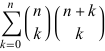
where  is a binomial coefficient and
 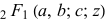 is a hypergeometric
function. These numbers have a surprising connection with the Cantor
set (E. W. Weisstein, Apr. 9, 2006).
is a hypergeometric
function. These numbers have a surprising connection with the Cantor
set (E. W. Weisstein, Apr. 9, 2006).
They also satisfy the recurrence equation
 |
(11)
|
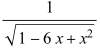
They have generating function
 |  |  |
(12)
|
 |  |  |
(13)
|
The values of  for
for  ,
2, ... are 3, 13, 63, 321, 1683, 8989, 48639, ... (OEIS A001850).
The numbers of decimal digits in
,
2, ... are 3, 13, 63, 321, 1683, 8989, 48639, ... (OEIS A001850).
The numbers of decimal digits in  for
for  , 1, ... are 1, 7, 76, 764, 7654, 76553, 765549, 7655510,
... (OEIS A114470), where the digits
approach those of
, 1, ... are 1, 7, 76, 764, 7654, 76553, 765549, 7655510,
... (OEIS A114470), where the digits
approach those of  (OEIS A104178).
The first few prime Delannoy numbers are 3, 13, 265729, ... (OEIS A092830), corresponding to indices
1, 2, 8, ..., with no others for  (Weisstein, Mar. 8, 2004).
The Schröder numbers bear the same relation to the Delannoy numbers as the Catalan numbers do to the binomial coefficients.
Amazingly, taking the Cholesky decomposition of the square array of  ,
transposing, and multiplying
it by the diagonal matrix
,
transposing, and multiplying
it by the diagonal matrix  gives the square
matrix (i.e., lower triangular) version
of Pascal's triangle (G. Helms, pers. comm.,
Aug. 29, 2005).
gives the square
matrix (i.e., lower triangular) version
of Pascal's triangle (G. Helms, pers. comm.,
Aug. 29, 2005).
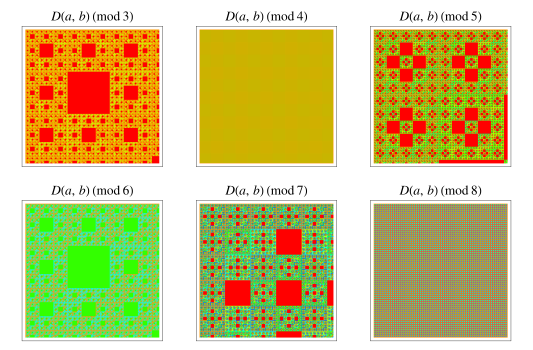
Beautiful fractal patterns can be obtained by plotting  (mod
(mod  ) (E. Pegg, Jr., pers. comm., Aug. 29, 2005). In
particular, the
) (E. Pegg, Jr., pers. comm., Aug. 29, 2005). In
particular, the  case corresponds to a pattern resembling the Sierpiński
carpet.
case corresponds to a pattern resembling the Sierpiński
carpet.

 with Diagonal Steps." Canad. Math. Bull. 10, 653-658, 1967.Vardi,
I.
with Diagonal Steps." Canad. Math. Bull. 10, 653-658, 1967.Vardi,
I.