


A trinomial coefficient is a coefficient of the trinomial triangle. Following the notation of Andrews (1990), the trinomial coefficient
 ,
with
,
with  and
and  ,
is given by the coefficient of
,
is given by the coefficient of  in the expansion of
  . Therefore,
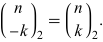 |
(1)
|
The trinomial coefficient can be given by the closed form
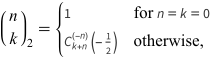 |
(2)
|
where  is a Gegenbauer polynomial.
Equivalently, the trinomial coefficients are defined by
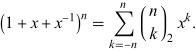 |
(3)
|
The trinomial coefficients also have generating function
 |  | 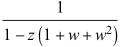 |
(4)
|
 |  |  |
(5)
|
i.e.,
 |
(6)
|
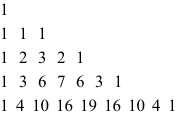
The trinomial triangle gives the triangle of trinomial coefficients,
 |
(7)
|
(OEIS A027907).
The central column of the trinomial triangle gives the central trinomial coefficients.
The trinomial coefficient is also given by the number of permutations of  symbols, each
  , 0, or 1, which sum to
  . For example, there are seven permutations of three symbols
which sum to 0,
. For example, there are seven permutations of three symbols
which sum to 0,  ,
,
 ,
,
 ,
,
 ,
and
,
and  ,
,
 ,
,
 ,
so
,
so  .
.
An alternative (but different) definition of the trinomial coefficients is as the coefficients in  (Andrews 1990), which is therefore a multinomial
coefficient with
(Andrews 1990), which is therefore a multinomial
coefficient with  , giving
 |
(8)
|
Trinomial coefficients have a rather sparse literature, although no less than Euler (in 1765) authored a 20-page paper on their properties (Andrews 1990).
The following table gives the first few columns of the trinomial triangle.
 | OEIS |  -trinomial coefficients -trinomial coefficients |
| 0 | A002426 | 1, 1, 3, 7, 19, 51, 141, 393, 1107, 3139, 8953, ... |
| 1 | A005717 | 1, 2, 6, 16, 45, 126, 357, 1016, 2907, 8350, ... |
| 2 | A014531 | 1, 3, 10, 30, 90, 266, 784, 2304, ... |
| 3 | A014532 | 1, 4, 15, 50, 161, 504, 1554, 4740, ... |
| 4 | A014533 | 1, 5, 21, 77, 266, 882, 2850, 9042, ... |
| 5 | A098470 | 1, 6, 28, 112, 414, 1452, 4917, ... |
The diagonals  are summarized in the following table.


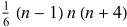





The trinomial coefficients satisfy an identity similar to that of the binomial coefficients, namely
 |
(9)
|
(Andrews 1990).
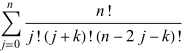
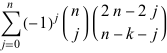
Explicit formulas for  are given by
 |  |  |
(10)
|
 |  |  |
(11)
|
(Andrews 1990), which gives the closed forms
 |  |  |
(12)
|
 |  |  |
(13)
|
where  is a regularized hypergeometric
function.
is a regularized hypergeometric
function.
For at least  and
and  ,
,
 is prime iff
  is prime (since in that case
  ) or
) or  , (3, 0), or (4, 0). It is apparently not known if
this property holds for all
, (3, 0), or (4, 0). It is apparently not known if
this property holds for all  . However, the
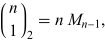
  column is explicitly given by
 |
(14)
|
where  is a Motzkin number, and so can only be prime for
 .
.
In 1765, Euler noted the pretty near-identity of central trinomial coefficients
 |
(15)
|
where  is a Fibonacci number, which holds only for
  (Andrews 1990). For
  , 1, ..., the first few values of the left side are (OEIS
A103872), while the values on the right side
are 0, 2, 2, 6, 12, 30, 72, 182, ... (OEIS A059727).
A couple of pages of Euler's works containing the near-identity was sent by D. Knuth
to R. K. Guy, who included it in his article on the strong
law of small numbers (Guy 1990). Meanwhile, Guy had met G. Andrews at the
Bateman retirement conference and showed it to him. Half an hour later, Andrews came
back with the
, 1, ..., the first few values of the left side are (OEIS
A103872), while the values on the right side
are 0, 2, 2, 6, 12, 30, 72, 182, ... (OEIS A059727).
A couple of pages of Euler's works containing the near-identity was sent by D. Knuth
to R. K. Guy, who included it in his article on the strong
law of small numbers (Guy 1990). Meanwhile, Guy had met G. Andrews at the
Bateman retirement conference and showed it to him. Half an hour later, Andrews came
back with the  -series
identity from which Euler's near result follows. In particular, defining
-series
identity from which Euler's near result follows. In particular, defining
![E_n(a,b)=sum_(k=-infty)^infty[(n; 10k+a)_2-(n; 10k+b)_2]](/images/equations/TrinomialCoefficient/NumberedEquation10.svg) |
(16)
|
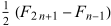
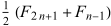
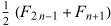
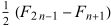
gives the identities
 |  |  |
(17)
|
 |  |  |
(18)
|
 |  |  |
(19)
|
 |  |  |
(20)
|
 |  |  |
(21)
|
 |  |  |
(22)
|
 |  |  |
(23)
|
 |  |  |
(24)
|
 |  |  |
(25)
|
 |  |  |
(26)
|
 |  |  |
(27)
|
 |  |  |
(28)
|
 |  |  |
(29)
|
 |  |  |
(30)
|
 |  |  |
(31)
|
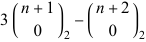
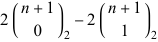
(Andrews 1990). This then leads to the near-identity via
 |  |  |
(32)
|
 |  |  |
(33)
|
 |  |  |
(34)
|
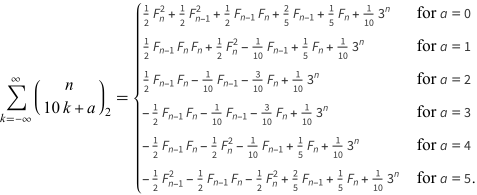
Andrews (1990) also gave the pretty identities
 |
(35)
|

 -Trinomial
Coefficients." J. Amer. Math. Soc. 3, 653-669, 1990.Andrews,
G. and Baxter, R. J. "Lattice Gas Generalization of the Hard Hexagon Model.
III.
-Trinomial
Coefficients." J. Amer. Math. Soc. 3, 653-669, 1990.Andrews,
G. and Baxter, R. J. "Lattice Gas Generalization of the Hard Hexagon Model.
III.  -Trinomial
Coefficients." J. Stat. Phys. 47, 297-330, 1987.Comtet,
L.
-Trinomial
Coefficients." J. Stat. Phys. 47, 297-330, 1987.Comtet,
L.  -Trinomial Identities." 5 Oct. 1998.