Every Meyer set is a Delone set. Indeed, for any , the translate is a subset
of , so the uniform separation condition
also holds for .
An -dimensional point
lattice in
is a Meyer set because its difference set is itself. Consequently, Meyer sets need
not be nonperiodic. They provide a broader mathematical framework for quasicrystals
(Moody 1997).
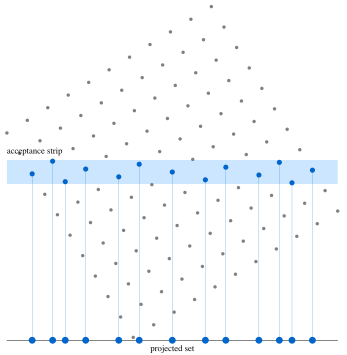
For a one-dimensional example, rotate the integer lattice through an angle whose tangent is the negative
of the golden ratio, retain the lattice
points in a horizontal strip, and take their orthogonal
projection onto the horizontal line (Moody 2000). The
illustration shows a finite patch with strip half-width
. The resulting infinite set
is a Meyer set.
Barache, D.; Champagne, B.; and Gazeau, J.-P. "Pisot-Cyclotomic Quasilattices and Their Symmetry Semigroups." In Quasicrystals and Discrete
Geometry (Ed. J. Patera). Providence, RI: Amer. Math. Soc., pp. 15-66,
1998.Moody, R. V. "Meyer Sets and Their Duals." In The
Mathematics of Long-Range Aperiodic Order (Ed. R. V. Moody). Dordrecht,
Netherlands: Kluwer, pp. 403-441, 1997. https://doi.org/10.1007/978-94-015-8784-6_16.Moody,
R. V. "Model Sets: A Survey." In From Quasicrystals to More Complex
Systems (Ed. F. Axel, F. Dénoyer, and J.-P. Gazeau). Les
Ulis, France: EDP Sciences and Berlin, Germany: Springer-Verlag, pp. 145-166,
2000. https://arxiv.org/abs/math/0002020.Trott,
M. The
Mathematica GuideBook for Graphics. New York: Springer-Verlag, 2004. §1.1.1.
https://www.mathematicaguidebooks.org/.


 of Euclidean
space
 whose difference set

 have a common positive lower bound
on their separation.
 , the translate
 is a subset
of
 , so the uniform separation condition
also holds for
 .
An
 -dimensional point
lattice in
 is a Meyer set because its difference set is itself. Consequently, Meyer sets need
not be nonperiodic. They provide a broader mathematical framework for quasicrystals
(Moody 1997).
 . The resulting infinite set
is a Meyer set.
