for some
(Davenport 1980, Vardi 1991). The prime number
theorem is equivalent to the statement
(5)
as
(Dusart 1999), or equivalently
(6)
Von Mangoldt rigorously derived the explicit formula in 1895, roughly three decades after the 1859 paper of Riemann that inspired it.
The formula subsequently played a central role in proofs of the prime
number theorem, whose equivalent formulation above is (Edwards 2001, pp. 49-54).
Costa Pereira, N. "Estimates for the Chebyshev Function ."
Math. Comput.44, 211-221, 1985.Costa Pereira, N. "Corrigendum:
Estimates for the Chebyshev Function ." Math. Comput.48, 447,
1987.Costa Pereira, N. "Elementary Estimates for the Chebyshev
Function
and for the Möbius Function ." Acta Arith.52, 307-337, 1989.Davenport,
H. Multiplicative
Number Theory, 2nd ed. New York: Springer-Verlag, p. 114, 1980.Dusart,
P. "Inégalités explicites pour , , et les nombres premiers." C. R. Math. Rep. Acad.
Sci. Canad21, 53-59, 1999.Edwards, H. M. "Derivation
of von Mangoldt's Formula for ." §3.2 in Riemann's
Zeta Function. New York: Dover, pp. 49-54, 2001.Montgomery,
H. L. "Harmonic Analysis as Found in Analytic Number Theory." In Twentieth
Century Harmonic Analysis--A Celebration. Proceedings of the NATO Advanced Study
Institute Held in Il Ciocco, July 2-15, 2000 (Ed. J. S. Byrnes).
Dordrecht, Netherlands: Kluwer, pp. 271-293, 2001.Rosser, J. B.
and Schoenfeld, L. "Sharper Bounds for Chebyshev Functions and ." Math. Comput.29, 243-269, 1975.Schoenfeld,
L. "Sharper Bounds for Chebyshev Functions and . II." Math. Comput.30, 337-360, 1976.Vardi,
I. Computational
Recreations in Mathematica. Reading, MA: Addison-Wesley, pp. 146-147
and 152-155, 1991.


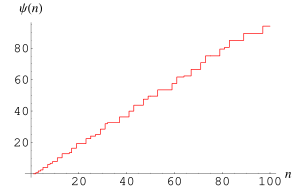
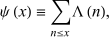
 is the Mangoldt function. It is also called
the second Chebyshev function (Edwards 2001,
p. 51).
is the Mangoldt function. It is also called
the second Chebyshev function (Edwards 2001,
p. 51).
 not equal to a prime or prime
power, it is given by the explicit formula
not equal to a prime or prime
power, it is given by the explicit formula

 of the Riemann zeta function
  , i.e., those in the critical
strip so
, i.e., those in the critical
strip so ![0<Re[rho]<1](/images/equations/MangoldtSummatoryFunction/Inline5.svg) (Montgomery 2001), and is interpreted as
(Montgomery 2001), and is interpreted as


 (Davenport 1980, Vardi 1991). The prime number
theorem is equivalent to the statement
(Davenport 1980, Vardi 1991). The prime number
theorem is equivalent to the statement

 (Dusart 1999), or equivalently

 (Edwards 2001, pp. 49-54).


 is the floor function and
  is a factorial.

 ."
Math. Comput. 44, 211-221, 1985.Costa Pereira, N. "Corrigendum:
Estimates for the Chebyshev Function
."
Math. Comput. 44, 211-221, 1985.Costa Pereira, N. "Corrigendum:
Estimates for the Chebyshev Function  ." Math. Comput. 48, 447,
1987.Costa Pereira, N. "Elementary Estimates for the Chebyshev
Function
." Math. Comput. 48, 447,
1987.Costa Pereira, N. "Elementary Estimates for the Chebyshev
Function  and for the Möbius Function
  ." Acta Arith. 52, 307-337, 1989.Davenport,
H.
." Acta Arith. 52, 307-337, 1989.Davenport,
H.  ,
,  ,
,  et les nombres premiers." C. R. Math. Rep. Acad.
Sci. Canad 21, 53-59, 1999.Edwards, H. M. "Derivation
of von Mangoldt's Formula for
et les nombres premiers." C. R. Math. Rep. Acad.
Sci. Canad 21, 53-59, 1999.Edwards, H. M. "Derivation
of von Mangoldt's Formula for  ." §3.2 in
  and
and  ." Math. Comput. 29, 243-269, 1975.Schoenfeld,
L. "Sharper Bounds for Chebyshev Functions
." Math. Comput. 29, 243-269, 1975.Schoenfeld,
L. "Sharper Bounds for Chebyshev Functions  and
and  . II." Math. Comput. 30, 337-360, 1976.Vardi,
I.
. II." Math. Comput. 30, 337-360, 1976.Vardi,
I.