


The name lima bean curve is used here for the quartic curve with polar equation
 |
(1)
|
(Wassenaar). It is also given by the Cartesian equation
 |
(2)
|
Replacing the right-hand side  by
 gives the distinct bean
curve, a quartic curve that in its usual orientation
is symmetric about the
 -axis rather than the line
 .
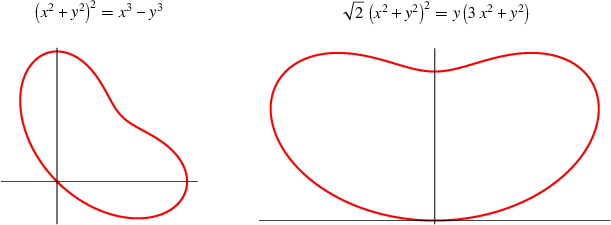
The left figure above shows the curve in its original orientation. The right figure shows the same curve after a counterclockwise
rotation through  . In this orientation, the
curve lies in the
 half-plane and is symmetric
about the
 -axis; its Cartesian equation
is
 |
(3)
|
The parametric equations for the original polar curve are
 |  |  |
(4)
|
 |  |  |
(5)
|
For  , this curve has maximum
values
 and minimum values
 , where
 is the real root
of
 . The area
enclosed by the curve is
 |  |  |
(6)
|
 |  |  |
(7)
|
The digits in the numerical value are those of OEIS A244978 shifted one place, since  . The geometric
centroid
 of the interior is given by
 |  |  |
(8)
|
 |  |  |
(9)
|
and the perimeter by
 |  |  |
(10)
|
 |  |  |
(11)
|
 |  | 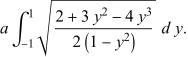 |
(12)
|
This perimeter has a closed form in terms of a Lauricella function. Set
 |  |  |
(13)
|
 |  |  |
(14)
|
 |  |  |
(15)
|
 |  |  |
(16)
|
Since  and
 , the defining series
for
 does not converge at these arguments. The required analytic
continuation is specified by the following real integral.
It is Euler-type because it is built from the beta integral
kernel
 :
 |
(17)
|
Therefore,
 |  |  |
(18)
|
 |  |  |
(19)
|
(OEIS A336501; E. Weisstein, Aug. 27, 2026).
The area moment of inertia tensor of the interior about the origin is given by
 |
(20)
|
