

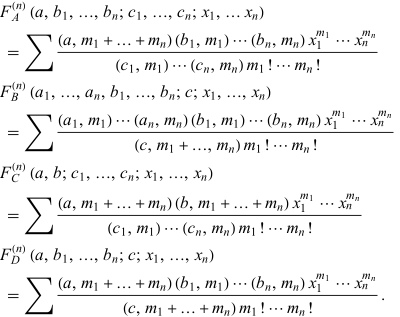
Lauricella functions are generalizations of the Gauss hypergeometric functions to multiple variables. Four such generalizations were investigated by Lauricella (1893),
and more fully by Appell and Kampé de Fériet (1926, p. 117). Let
 be the number of variables, then the Lauricella functions are defined by
 |  |  |
(1)
|
 |  |  |
(2)
|
 |  |  |
(3)
|
 |  |  |
(4)
|
A direct application of  to products of Bessel
functions of the first kind is given by the Weber-Schafheitlin
integral.
to products of Bessel
functions of the first kind is given by the Weber-Schafheitlin
integral.
The respective domains of absolute convergence of the defining series are
 |
(5)
|
(Exton 1978, pp. 29-30).
For ![Re[c]>Re[a]>0](/images/equations/LauricellaFunctions/Inline15.svg) ,
the Lauricella function
,
the Lauricella function  has the Euler-type integral representation
 |
(6)
|
Along  ,
all powers are principal. Initially, each
,
all powers are principal. Initially, each  is taken in
  , which keeps
  off the standard branch cut
 ![(-infty,0]](/images/equations/LauricellaFunctions/Inline21.svg) . Other values are obtained
by analytic continuation, using consistent
choices of the powers and, when necessary, deforming the integration contour
to avoid singularities (Exton 1976, Ch. 5).
. Other values are obtained
by analytic continuation, using consistent
choices of the powers and, when necessary, deforming the integration contour
to avoid singularities (Exton 1976, Ch. 5).
If  ,
then these functions reduce to the Appell
hypergeometric functions
,
then these functions reduce to the Appell
hypergeometric functions  ,
,  ,
,  , and
, and  , respectively. If
  , all four become the Gauss hypergeometric function
  (Exton 1978, p. 29).
For generic parameters, the Horn systems associated with  and
and  have holonomic ranks
  , while the system associated with
  has rank
  (Banik and Bera 2026). Outside the domains above, the functions
require analytic continuation. One numerical
approach constructs the associated first-order Pfaffian
system, restricts it to a one-dimensional path, and matches generalized power-series
solutions using the Frobenius method. Banik and
Bera (2026) describe a high-precision implementation of this approach for all four
Lauricella families.
(Banik and Bera 2026). Outside the domains above, the functions
require analytic continuation. One numerical
approach constructs the associated first-order Pfaffian
system, restricts it to a one-dimensional path, and matches generalized power-series
solutions using the Frobenius method. Banik and
Bera (2026) describe a high-precision implementation of this approach for all four
Lauricella families.
