TOPICS
Search

Bean Curve


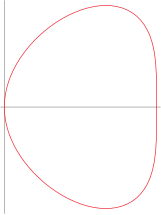
A bean curve is one of several plane curves known by that name.
BeanCurve

The bean curve identified by Cundy and Rowllet (1989, p. 72) is the quartic curve given by the implicit equation

 x^4+x^2y^2+y^4=ax(x^2+y^2).
(1)

It has horizontal tangents at (2/3a,+/-2/3a) and vertical tangents at (0,0) and (a,0). The area enclosed by the curve is given by

A=sqrt(2)a^2int_0^1sqrt(x(1-x+sqrt(1+(2-3x)x)))dx
(2)
=(7pia^2)/(12sqrt(3))
(3)
=1.058049...a^2
(4)

(OEIS A193505).

The geometric centroid (x^_,y^_) of the interior is given by

x^_=(23)/(42)a
(5)
y^_=0.
(6)

The area moment of inertia tensor of the interior is given by

I_(xx)=(113pi)/(1728sqrt(3))a^4
(7)
I_(xy)=0
(8)
I_(yy)=(23pi)/(108sqrt(3))a^4
(9)

(E. Weisstein, Feb. 3-5, 2018).

The perimeter admits an exact representation in terms of the seven-variable Lauricella function F_D^((7)). Let z_1, ..., z_5 be the roots of

 z^5-2z^4-5z^3+26z^2-27z+8=0,
(10)

and set w_+/-=e^(+/-ipi/3). Then

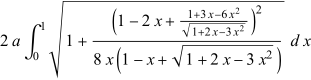
s=2aint_0^1sqrt(1+((1-2x+(1+3x-6x^2)/(sqrt(1+2x-3x^2)))^2)/(8x(1-x+sqrt(1+2x-3x^2))))dx
(11)
=piaF_D^((7))(1/2;-1/2,-1/2,-1/2,-1/2,-1/2,2,2;1;z_1,z_2,z_3,z_4,z_5,w_+,w_-)
(12)
=3.75021364515724...a,
(13)

(OEIS A193506). The defining series does not converge at these arguments, so F_D^((7)) is understood by analytic continuation through its Euler integral representation. The Euler integral independently reproduces the numerical value above.


LimaBeanCurve

The left figure above shows a second bean curve that more closely resembles an actual bean (in particular, a lima bean), here called the "lima bean curve." In this original orientation, it is given by the simple polar equation

 r=a(sin^3theta+cos^3theta)
(14)

(Wassenaar). It is also a quartic curve, with Cartesian equation

 (x^2+y^2)^2=a(x^3+y^3).
(15)

The right figure shows the same curve after a counterclockwise rotation through pi/4. In this orientation, the curve lies in the y>=0 half-plane and is symmetric about the y-axis; its Cartesian equation is

 sqrt(2)(x^2+y^2)^2=ay(3x^2+y^2).
(16)

The parametric equations for the left-hand original polar curve are

x=acost(sin^3t+cos^3t)
(17)
y=asint(sin^3t+cos^3t).
(18)

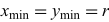
For a>0, this curve has maximum values x_(max)=y_(max)=a and minimum values x_(min)=y_(min)=ar, where r=-0.28288... is the real root of 27-27r-288r^2+512r^3=0. The area enclosed by the curve is

A=5/(16)pia^2
(19)
=0.98174770...a^2
(20)

The digits in the numerical value are those of OEIS A244978 shifted one place, since 5pi/16=10(pi/32). The geometric centroid (x^_,y^_) of the interior is given by

x^_=3/(10)a
(21)
y^_=3/(10)a,
(22)

and the perimeter by

s=aint_0^pisqrt(1+3/2sin^2(2theta)-2sin^3(2theta))dtheta
(23)
=1/2aint_0^(2pi)sqrt(1+3/2sin^2x-2sin^3x)dx
(24)
=aint_(-1)^1sqrt((2+3y^2-4y^3)/(2(1-y^2)))dy.
(25)

This perimeter has a closed form in terms of a Lauricella function. Set

q=(1+sqrt(2))^(1/3)
(26)
z_0=4/3-2/3(q-1/q)
(27)
z_+=4/3+1/3(q-1/q)+i/(sqrt(3))(q+1/q)
(28)
z_-=z^__+.
(29)

Since |z_+|>1 and |z_-|>1, the defining series for F_D does not converge at these arguments. The required analytic continuation is specified by the following real integral. It is Euler-type because it is built from the beta integral kernel t^(-1/2)(1-t)^(-1/2):

 F_D^((3))(1/2;-1/2,-1/2,-1/2;1;z_0,z_+,z_-)=1/piint_0^1t^(-1/2)(1-t)^(-1/2)(1-z_0t)^(1/2)|1-z_+t|dt.
(30)

Therefore,

s=(3pia)/(sqrt(2))F_D^((3))(1/2;-1/2,-1/2,-1/2;1;z_0,z_+,z_-)
(31)
=3.931702798...a.
(32)

(OEIS A336501).

The area moment of inertia tensor of the interior is given by

 I=[(123pi)/(2048)a^4 -(9pi)/(1024)a^4; -(9pi)/(1024)a^4 (123pi)/(2048)a^4].
(33)

See also

Bicuspid Curve, Limaçon

Explore with Wolfram|Alpha

References

Cundy, H. and Rollett, A. Mathematical Models, 3rd ed. Stradbroke, England: Tarquin Pub., p. 72, 1989.Sloane, N. J. A. Sequences A193505, A193506, A244978, and A336501 in "The On-Line Encyclopedia of Integer Sequences."Wassenaar, J. "Mathematical Curves: Bean Curve (1)." https://www.2dcurves.com/quartic/quarticbn.html.Wassenaar, J. "Mathematical Curves: Bean Curve (2)." https://www.2dcurves.com/quartic/quarticbn2.html.

Referenced on Wolfram|Alpha

Bean Curve

Cite this as:

Weisstein, Eric W. "Bean Curve." From MathWorld--A Wolfram Resource. https://mathworld.wolfram.com/BeanCurve.html

Subject classifications