


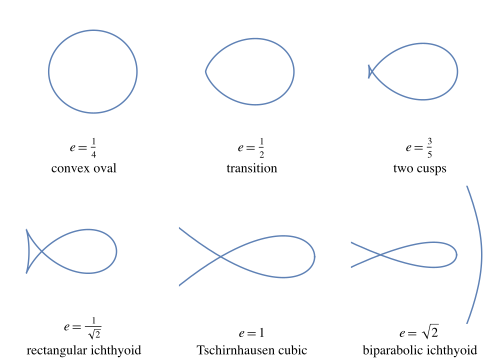
An ichthyoid curve is the negative pedal curve of a conic section with respect to a focus
(Cundy 2001). Its elliptic members are Burleigh's ovals,
including the fish curve, while the parabolic member
is the Tschirnhausen cubic. The figure shows
representative members in order of increasing eccentricity  . Each panel is independently scaled without distorting
its shape, and the unbounded branches in the last two panels continue beyond the
displayed windows.
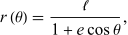
Place the focus at the origin and write the base conic section using the polar equation
 |
(1)
|
where  is the semilatus rectum and
 is the eccentricity.
For a hyperbola, negative values of the radial coordinate
 include its second branch. The
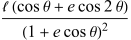
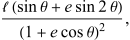
envelope of the lines through
points of the conic section and perpendicular
to their focal radii has parametric equations
 |  |  |
(2)
|
 |  |  |
(3)
|
with values for which  excluded. The parameter
 sets the scale, while
 determines the shape (Cundy 2001).
For  the curve is a circle, and for
 it is a smooth convex ovoid. At
 it has a singular transition point. For
 it has two cusps and
an ordinary double point at
 |
(4)
|
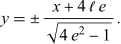
The two tangent lines at the ordinary double point are
 |
(5)
|
They are perpendicular when  , giving the rectangular ichthyoid, or fish curve.
For  the base conic section is a parabola,
and the curve is the Tschirnhausen cubic with
Cartesian equation
 |
(6)
|
For  the base conic section is a hyperbola.
Its ichthyoid has two components, one with an ordinary
double point, and is called a biparabolic ichthyoid. The two asymptotes
of the base hyperbola have parabolas
as their negative pedal curves (Cundy 2001).
Except for the circle at
 and the cubic curve at
 , the family consists of quartic
curves.
