


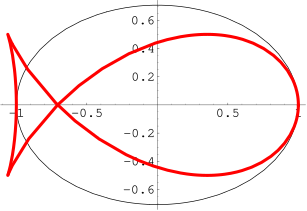
The fish curve is a term coined in this work for the ellipse negative pedal curve with pedal point at the focus for the special case of the eccentricity  . This is the rectangular ichthyoid in the ichthyoid curve family (Cundy 2001). Deakin (1994)
proposed the name "Lockwood's goldfish" for this curve.
For an ellipse with parametric equations
 |  |  |
(1)
|
 |  |  |
(2)
|
the corresponding fish curve has parametric equations
 |  |  |
(3)
|
 |  |  |
(4)
|
The Cartesian equation is
 |
(5)
|
which, when the origin is translated to the node, can be written
 |
(6)
|
(Lockwood 1957).
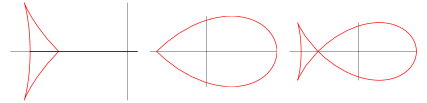
The interior of the curve is not consistently oriented in the above parametrization, with the fish's head being on the left of the curve and the tail on the right as the curve is traversed. Its signed area therefore subtracts one piece from the other. Treating the two pieces separately instead gives the areas of the tail and head as
 |  |  |
(7)
|
 |  |  |
(8)
|
giving an overall area for the fish as
 |
(9)
|
(Lockwood 1957, Deakin 1994).
The arc length of the curve is given by
 |  |  |
(10)
|
 |  |  |
(11)
|
 |  |  |
(12)
|
(Lockwood 1957).
The curvature and tangential angle are given by
 |  |  |
(13)
|
 |  |  |
(14)
|
where  is the complex
argument.
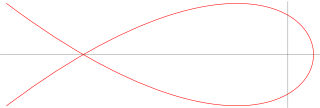
The Tschirnhausen cubic, illustrated above, also resembles a fish, as does the trefoil curve.
