

A hyperlinear group is a group whose finite portions admit arbitrarily accurate unitary matrix
models in normalized Hilbert-Schmidt norm
that keep distinct elements separated (Pestov 2008). For an  complex matrix
 , this norm is
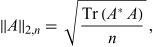 |
(1)
|
where  is the conjugate transpose and
 denotes the matrix trace
of a matrix
 . Precisely, for every finite
symmetric subset
 containing the identity element
 and every
 , there are a positive
integer
 and a map
 with
 such that
 |
(2)
|
whenever  , and
 |
(3)
|
for distinct  . Here
 is the unitary group,
 is the identity matrix, and the matrix
size is unrestricted. Every sofic group is hyperlinear.
This definition differs from the operator norm approximation
defining an MF group.
For a countable group  , hyperlinearity is equivalent to a trace-preserving
embedding of its group von Neumann algebra
 , with its canonical trace, into an ultrapower
of the hyperfinite type
 factor (Pestov 2008). A nonembeddable tracial algebra with
some other trace does not by itself give a nonhyperlinear group.
Alekseev et al. (2026) reported a proof of the existence of nonhyperlinear groups. More generally, let  be groups with Kazhdan's
property (T) such that the elements
 satisfying
 generate
 . If
 is not normal in
 , then the amalgamated
free product
 is not hyperlinear. Their proof builds on Thom's earlier
conditional argument. The work builds on a proof obtained
by Danus using GPT-6 Astra, and the joint proof was developed
with mathematical assistance from ChatGPT and Codex.
