

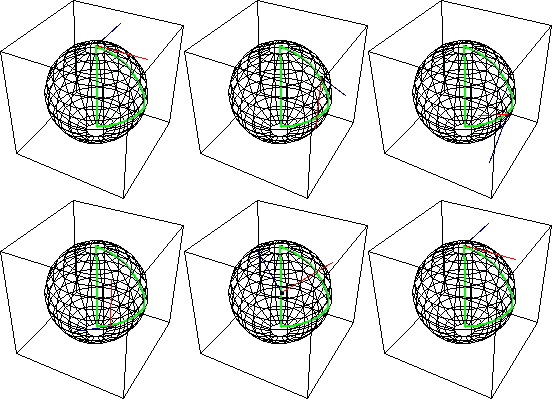
The holonomy group of a Riemannian manifold  consists of the linear
transformations obtained by parallel transport
along closed loops at a basepoint
 . Parallel
transport of manifold tangent vectors
along a path preserves vector
addition and scalar multiplication.
So a loop at the basepoint
 gives rise to an invertible
linear map of
 ,
the tangent space at
 . It is possible to compose closed loops
by following one after the other, and to invert them by going backwards. Hence, the
set of linear transformations
arising from parallel transport along closed
loops is a group, called the holonomy
group.
The restricted holonomy group is obtained by considering only loops that are homotopic to the constant loop
at  . It is the connected
component of the identity element in the
full holonomy group.
Since parallel transport preserves the Riemannian metric, the holonomy group is contained in the orthogonal
group  .
Moreover, if the manifold is orientable,
then it is contained in the special orthogonal
group. A generic Riemannian metric on an
orientable manifold has holonomy group
 , but for some special Riemannian
metrics it can be a proper subgroup of
 , in which case the manifold
is said to have special holonomy.
A Kähler manifold is a  -dimensional manifold
whose holonomy lies in the unitary group
 . A smooth Calabi-Yau
space is a
 -dimensional manifold with
holonomy in the special unitary group. A
 -dimensional manifold with holonomy group contained in
 , the quaternionic unitary group, is called a hyper-Kähler
manifold, and, for
 ,
one with holonomy
 is called a quaternion Kähler manifold.
Berger (1955) classified the possible restricted holonomy groups
of the metric-compatible Levi-Civita
connection on locally irreducible, locally nonsymmetric Riemannian
manifolds. Under these hypotheses, the other possibilities are the Lie
groups
 and
 .
Berger (1955) also listed
 as a possible restricted holonomy group under these
hypotheses, but Brown and Gray (1972) excluded this possibility.
On a flat manifold, two homotopic loops give the same linear
transformation. Consequently, parallel transport
defines a group representation of the fundamental group of  whose image is the holonomy group.
In general though, the Riemann tensor of
 affects the parallel transport
between homotopic loops. In
fact, there is a formula for the difference as an integral
of the Riemann tensor.

 ." In Differential Geometry (In Honor of Kentaro
Yano) (Ed. S. Kobayashi, M. Obata, and T. Takahashi). Tokyo, Japan:
Kinokuniya Book-Store, pp. 41-59, 1972.