

Parallel transport on a manifold  makes precise the idea of translating a vector
field
makes precise the idea of translating a vector
field  along a smooth curve to attain a new vector
field
along a smooth curve to attain a new vector
field  which is parallel to
  .
More precisely, let
.
More precisely, let  be a smooth manifold with affine connection
  , let
, let  be a smooth curve
from an interval
be a smooth curve
from an interval  into
into  , and let
  be a vector
tangent to
be a vector
tangent to  at
at  for some
  .
A vector field
.
A vector field  along
along  is the parallel transport of
  provided that
  and
and  is covariantly constant, meaning that
 |
(1)
|
for all  , where
  denotes the covariant
derivative of
denotes the covariant
derivative of  along
along  associated to
  .
.
A standard result in differential geometry is that, under the above hypotheses, parallel transports are unique.
In addition to the transported vector field, parallel transport can be viewed in a functional analytic way. Given  , parallel transport along
  from
from  to
to  is the linear transformation
 |
(2)
|
which maps  to
to  .
It is obvious that this linear transformation
is invertible, its inverse
being given simply by parallel transport along the reversed portion of
.
It is obvious that this linear transformation
is invertible, its inverse
being given simply by parallel transport along the reversed portion of  from
from  to
to  . The expression
  also provides a way to recover the affine connection
from its parallel transport along all curves. In particular,
choose the reference parameter
also provides a way to recover the affine connection
from its parallel transport along all curves. In particular,
choose the reference parameter  , let
, let  and
and  , and let
  be a smooth vector field.
Then
be a smooth vector field.
Then
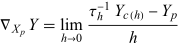 |
(3)
|
where  is the desired tangent vector at
  given by the connection
  and where
  .
.
