


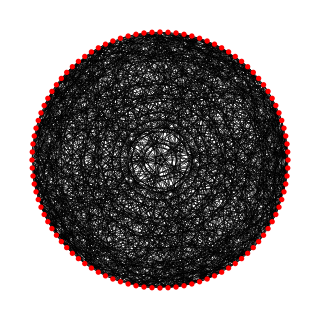
The Higman-Sims graph is the unique strongly regular graph with parameters  (Higman and Sims 1968, Brouwer 1983, Brouwer and
Haemers 1993). It was also constructed independently in Theorem 5.3 of Goethals and
Seidel (1970). It has regular parameters
(Higman and Sims 1968, Brouwer 1983, Brouwer and
Haemers 1993). It was also constructed independently in Theorem 5.3 of Goethals and
Seidel (1970). It has regular parameters  , where
  is the number of vertices,
 is the number of neighbors of each vertex,
  is the number of common neighbors shared by every adjacent
pair of vertices, and
is the number of common neighbors shared by every adjacent
pair of vertices, and  is the number of common neighbors shared by every nonadjacent
pair of vertices.
is the number of common neighbors shared by every nonadjacent
pair of vertices.
The Higman-Sims graph is implemented in the Wolfram Language as GraphData["HigmanSimsGraph"].
The Higman-Sims graph is distance-regular with intersection array 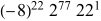 . It is also distance-transitive.
It is an integral graph with graph spectrum  .
.
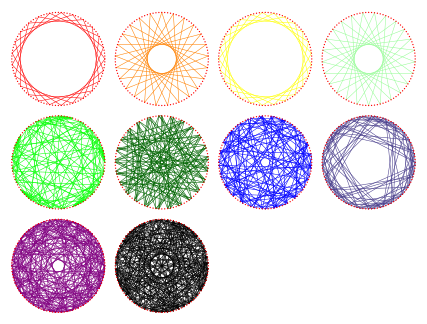
The graph drawing given at the top of this article is the graph sum of the ten graphs illustrated above which arise in the construction due to Hafner (2004).
It can be constructed by beginning with the 77 vectors of length 7 in the Witt design that contain the symbol 1, dropping the 1, and renumbering the remaining
elements from 1 to 22. Consider these vectors  as vertices, and adjoin an
additional 22 vertices
as vertices, and adjoin an
additional 22 vertices  and one special vertex
  . Now construct the 616 edges
between
. Now construct the 616 edges
between  whenever the intersection of
  and
and  is empty, the 462 edges between
 and
and  whenever
  is a member of
  ,
and the 22 edges between
,
and the 22 edges between  and every
  . Then the resulting graph on 100
vertices and 1100 edges
is the Higman-Sims graph.
. Then the resulting graph on 100
vertices and 1100 edges
is the Higman-Sims graph.
The Higman-Sims graph can be constructed from the Hoffman-Singleton graph by treating the latter's 100 independent vertex sets of size 15 as vertices and connecting by edges those pairs of independent vertex sets which share exactly 0 or 8 elements.
It can also be constructed from the Leech lattice by starting with three lattice points that form the vertices
of an isosceles triangle with side lengths
of 2,  ,
and
,
and  ,
identifying the exactly 100 lattice points that are at distance 2 from each triangle
vertex, and joining two points with an edge
if they are separated by distance
,
identifying the exactly 100 lattice points that are at distance 2 from each triangle
vertex, and joining two points with an edge
if they are separated by distance  . The resulting graph is the
Higman-Sims graph (Conway and Sloane 1999, pp. 292-293; Gaucher 2013; Brouwer
and van Maldeghem 2022, p. 303).
. The resulting graph is the
Higman-Sims graph (Conway and Sloane 1999, pp. 292-293; Gaucher 2013; Brouwer
and van Maldeghem 2022, p. 303).
The automorphism group of the Higman-Sims graph acts transitively on its edges (Brouwer and Haemers 1993).
The graph obtained by vertex deletion of the neighbors of a point in the Higman-Sims graph (which is not, as claimed by van Dam and Haemers 2003, the subgraph induced by the vertex neighbors) is the M22 graph.

 ." Math. Z. 105 , 110-113, 1968.House
of Graphs. "Higman Sims Graph."
." Math. Z. 105 , 110-113, 1968.House
of Graphs. "Higman Sims Graph."