


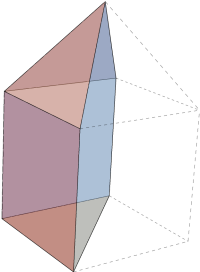
A hemiobelisk is one half of an obelisk, or elongated square pyramid. It is obtained by cutting an equilateral obelisk with unit edge lengths along a plane passing through opposite corners of its square base and the apex of the pyramid.
It is implemented in the Wolfram Language as PolyhedronData["Hemiobelisk"].
This solid is one of two having 7 vertices, 11 edges, and 6 faces (the other being the hemicube) and is an example of one of the 7 topological classes of convex hexahedron.
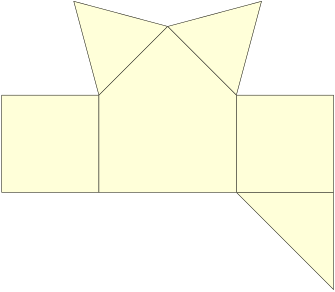
When constructed from a unit elongated square pyramid, the solid consists of two unit squares,
an isosceles right triangle with unit
base lengths, two unit equilateral triangles,
and an isosceles right pentagon with base length  and all other sides
of length 1.
and all other sides
of length 1.
A configuration of congruent copies gives the hemiobelisk Heesch number at least 1 in three dimensions. Pegg (2026) gave such a construction with 24 surrounding copies. For the geometric realization used in that construction, the vertices of a congruent copy can be taken as
 |
This realization is one of three congruent pieces in a polyhedron dissection of a heptahedron.
The heptahedron is obtained by attaching a regular
tetrahedron to a triangular face
of the space-filling polyhedron formed
by truncating a regular tetrahedron
at each vertex, one quarter of the way along
each edge (Pegg 2026). In the coordinates above,
each hemiobelisk has volume  .
.
This realization has nonzero Dehn invariant, so it is not a space-filling polyhedron.
The edges having dihedral
angles that are rational multiples of  contribute zero, while the remaining
edges give
contribute zero, while the remaining
edges give
![D=sqrt(2) tensor [cos^(-1)(1/3)]=-2sqrt(2)<3>_2!=0,](/images/equations/Hemiobelisk/NumberedEquation2.svg) |
where  denotes the tensor product over the rationals,
![[theta]](/images/equations/Hemiobelisk/Inline5.svg) denotes the equivalence
class of the dihedral angle
denotes the equivalence
class of the dihedral angle  modulo rational multiples
of
modulo rational multiples
of  , and
, and  is a basis angle
used in the Dehn invariant entry. Since
is a basis angle
used in the Dehn invariant entry. Since  is not an allowed rational cosine at a rational multiple
of
is not an allowed rational cosine at a rational multiple
of  by Niven's
theorem,
by Niven's
theorem, 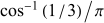 is irrational, so
 ![[cos^(-1)(1/3)]](/images/equations/Hemiobelisk/Inline12.svg) and therefore
and therefore  are nonzero.
The skeleton of the hemiobelisk is the hemiobelisk graph.

 Pegg, E. Jr. "The 3D Heesch Hemiobelisk: A Nonzero-Dehn-Invariant
Hexahedron with a Complete Corona." Wolfram Community. Sep. 14,
2026.
Pegg, E. Jr. "The 3D Heesch Hemiobelisk: A Nonzero-Dehn-Invariant
Hexahedron with a Complete Corona." Wolfram Community. Sep. 14,
2026.