

The Heesch number of a closed figure  in the plane is the largest nonnegative
integer
in the plane is the largest nonnegative
integer  for which
  can be completely surrounded
  times by congruent copies of
itself. Formally, let
times by congruent copies of
itself. Formally, let  .
A surrounding through the
.
A surrounding through the  th
corona consists of finite collections
th
corona consists of finite collections
 , ...,
  such that every member of
  is congruent to
  , all the copies have pairwise disjoint interiors, every member of
  has a common boundary point
with a member of
has a common boundary point
with a member of  ,
and the union of the copies in
,
and the union of the copies in  contains the union
of the copies in
contains the union
of the copies in  completely in its interior. The collection
  is the
  th corona (Bašić et
al. 2023). If no largest
th corona (Bašić et
al. 2023). If no largest  exists, the Heesch number is infinity.
The same definition applies in higher dimensions. In
particular, the hemiobelisk has Heesch number at
least 1 in three dimensions. The determination of the
maximum possible finite Heesch number is known as Heesch's
problem. The Heesch number of a triangle, quadrilateral,
regular hexagon, or any other shape that admits
a tiling of the plane, is infinity. Conversely, any shape with infinite
Heesch number must admit a tiling of the plane
(Eppstein).
exists, the Heesch number is infinity.
The same definition applies in higher dimensions. In
particular, the hemiobelisk has Heesch number at
least 1 in three dimensions. The determination of the
maximum possible finite Heesch number is known as Heesch's
problem. The Heesch number of a triangle, quadrilateral,
regular hexagon, or any other shape that admits
a tiling of the plane, is infinity. Conversely, any shape with infinite
Heesch number must admit a tiling of the plane
(Eppstein).
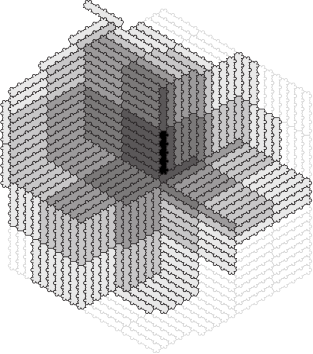
A tile invented by R. Ammann has Heesch number three (Senechal 1995), and Mann found an infinite family of tiles with Heesch number five (illustrated above). Bašić (2021) found a figure with Heesch number six, the largest finite value currently known.
A database of Heesch tilings is maintained by Mann (2008). An interactive atlas of computed Heesch constructions in two and three dimensions is maintained by Bakker (2026).
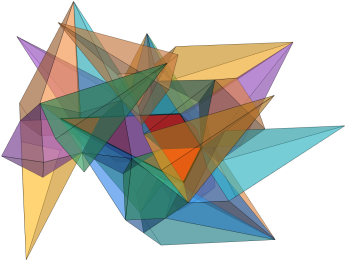
With AI assistance, Pegg (2026) constructed the "Heesch hemiobelisk" arrangement shown above. The central red solid and all 24 surrounding solids are congruent hemiobelisks. The colors distinguish individual copies. Of the surrounding copies, 14 meet the central hemiobelisk in a polygon, two in a line segment, and eight in a point. Exact intersection and volume calculations verify that the 25 solids have pairwise disjoint interiors and cover a neighborhood of the central hemiobelisk. Together with the central copy, the surrounding copies form a complete first corona, so the hemiobelisk has Heesch number at least 1 in three dimensions. Consequently, a convex polyhedron with nonzero Dehn invariant can have positive Heesch number in three dimensions. The exact Heesch number of this hemiobelisk and the minimum number of copies needed for a complete first corona remain unknown (Pegg 2026).
Straightforward Heesch constructions in three dimensions can be made from prisms over figures in two dimensions and from solids obtained by adding protrusions and recesses to the faces of a cube, with more protrusions than recesses (Pegg 2019). The hemiobelisk construction instead required modifying an unusual packing lattice.

 Pegg, E. Jr. "The 3D Heesch Hemiobelisk: A Nonzero-Dehn-Invariant
Hexahedron with a Complete Corona." Wolfram Community. Sep. 14,
2026.
Pegg, E. Jr. "The 3D Heesch Hemiobelisk: A Nonzero-Dehn-Invariant
Hexahedron with a Complete Corona." Wolfram Community. Sep. 14,
2026.  -Gons."