


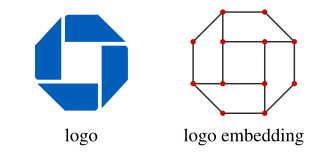
The Chase graph, a term coined here for the first time, is the graph on 12 vertices and 16 edges obtained from the line-segment skeleton of the octagonal symbol used by Chase Bank, the U.S. banking brand of JPMorgan Chase & Co., headquartered in New York City (JPMorganChase 2025, Chase 2026). The symbol was designed by Chermayeff and Geismar Associates for Chase Manhattan Bank and unveiled on Nov. 21, 1960 (JPMorganChase). The symbol is shown at left above (Chase), and the planar straight-line embedding that follows its outline is shown at right.
The HSBC graph is another planar graph defined by the boundaries of a bank logo.
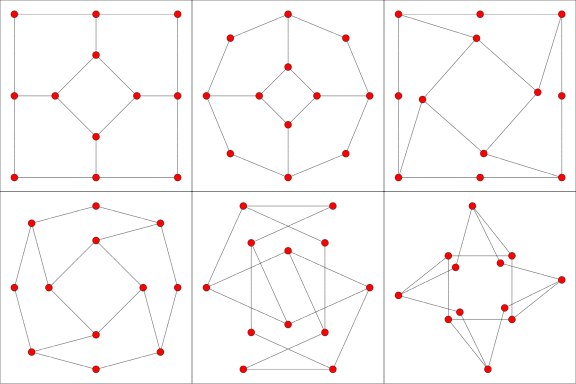
Six other straight-line graph drawings are shown above, four of which are unit-distance embeddings.
It has eight vertices of degree 3 and four of degree 2. It is a planar graph, a matchstick graph, and therefore a unit-distance graph. It has girth 4 and chromatic number 3.
The Chase graph is nonhamiltonian but traceable and has 24 Hamiltonian paths.
The Chase graph is implemented in the Wolfram Language as GraphData["ChaseGraph"].

