

Graph modularity assigns a score  to a proposed set partition
  of the vertex
set of a graph
of the vertex
set of a graph  . It is used in community
detection to measure how strongly the graph can be
divided into communities. The maximum modularity
of
. It is used in community
detection to measure how strongly the graph can be
divided into communities. The maximum modularity
of  ,
also called the modularity of
,
also called the modularity of  , is the maximum of this score
over all vertex partitions. A graph
community is a group of vertices that are more
strongly connected to one another than expected under a specified comparison model.
Let
, is the maximum of this score
over all vertex partitions. A graph
community is a group of vertices that are more
strongly connected to one another than expected under a specified comparison model.
Let  be a graph with
  edges, and let
  be a set partition of its
vertex set. For a part
be a set partition of its
vertex set. For a part  , let
, let  be the number of edges with
both endpoints in
be the number of edges with
both endpoints in  ,
and let
,
and let  be the sum of the vertex degrees
in
be the sum of the vertex degrees
in 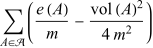 .
The modularity score of
.
The modularity score of  and the maximum modularity of
  are
are
 |  |  |
(1)
|
 |  |  |
(2)
|
Any set partition  satisfying
  is called a maximum-modularity partition.
The first term rewards edges lying within parts, while
the second subtracts a degree-based null-model expectation (Newman and Girvan 2004).
For every nonempty graph,
is called a maximum-modularity partition.
The first term rewards edges lying within parts, while
the second subtracts a degree-based null-model expectation (Newman and Girvan 2004).
For every nonempty graph,  ; by convention, an empty
graph has modularity zero. In the Wolfram
Language, GraphAssortativity[g,
partition, "Normalized" -> False] returns
; by convention, an empty
graph has modularity zero. In the Wolfram
Language, GraphAssortativity[g,
partition, "Normalized" -> False] returns  for the supplied set partition.
This evaluates that set partition only;
for the supplied set partition.
This evaluates that set partition only;  is the maximum over all partitions.
Let  and
and  be two parts of a set partition, and let
  be the number of edges
joining them. Merging the two parts changes the modularity score by
be the number of edges
joining them. Merging the two parts changes the modularity score by
 |
(3)
|
The merge improves the score exactly when  . Consequently, two distinct parts in
a maximum-modularity partition satisfy the reverse
weak inequality, while every bipartition
. Consequently, two distinct parts in
a maximum-modularity partition satisfy the reverse
weak inequality, while every bipartition  of one part satisfies
  .
.
If  and both volumes are positive, splitting
  strictly improves the score. It follows that, after
isolated vertices are removed, every part in every
maximum-modularity partition induces a connected
graph. The merge criterion also shows that no part can consist of a single nonisolated
vertex, so every tree leaf
belongs to the same part as its unique neighbor. Isolated
vertices may be deleted or assigned arbitrarily without changing modularity (Brandes
et al. 2008, Meeks and Skerman 2020).
strictly improves the score. It follows that, after
isolated vertices are removed, every part in every
maximum-modularity partition induces a connected
graph. The merge criterion also shows that no part can consist of a single nonisolated
vertex, so every tree leaf
belongs to the same part as its unique neighbor. Isolated
vertices may be deleted or assigned arbitrarily without changing modularity (Brandes
et al. 2008, Meeks and Skerman 2020).
For an exact decomposition, let  be the connected
components having
be the connected
components having  edges, let
  , and define the resolution-
 maximum of a graph
  with
with  edges by
 |
(4)
|
Then the globally normalized component identity is
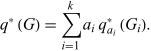 |
(5)
|
Indeed, after isolated vertices are removed, every optimal part lies in one connected component,
and its globally normalized contribution is  times its resolution-
 contribution. Thus the modularity of a disconnected
graph is not in general a sum, maximum,
or weighted mean of the ordinary values
contribution. Thus the modularity of a disconnected
graph is not in general a sum, maximum,
or weighted mean of the ordinary values  . However, if
  for every edge-bearing connected
component, the identity simplifies to
for every edge-bearing connected
component, the identity simplifies to
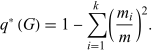 |
(6)
|
In particular, for  ,
the
,
the  -ladder rung graph
  is the disjoint graph union
of
is the disjoint graph union
of  one-edge connected components and therefore
has
one-edge connected components and therefore
has
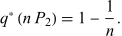 |
(7)
|
Its values are 0,  ,
,
 ,
,  , ..., with reduced numerators
0, 1, 2, 3, ... (OEIS A001477) and denominators
1, 2, 3, 4, ... (OEIS A000027).
, ..., with reduced numerators
0, 1, 2, 3, ... (OEIS A001477) and denominators
1, 2, 3, 4, ... (OEIS A000027).
For the cycle graph  with
with  , a maximum-modularity partition
may be chosen to consist of contiguous paths whose
sizes differ by at most one (Brandes et al. 2008). Set
, a maximum-modularity partition
may be chosen to consist of contiguous paths whose
sizes differ by at most one (Brandes et al. 2008). Set  ,
,  , and
, and  , where
  is the floor function.
Then, for
is the floor function.
Then, for  ,
,
 |
(8)
|
At  for
for  ,
partitions into
,
partitions into  and
and  parts tie. In particular,
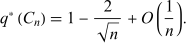 |
(9)
|
where  denotes big-O notation (McDiarmid and Skerman 2018).
Every complete graph and every complete multipartite graph has modularity zero. McDiarmid and Skerman (2026) proved that,
for  ,
the fewest edges that can be deleted from
,
the fewest edges that can be deleted from  to obtain positive modularity is
  , where
  is the floor function.
For the binomial random graph
is the floor function.
For the binomial random graph  in the very dense regime
  , they found a transition governed by the average
vertex degree of the complementary
graph. For fixed
, they found a transition governed by the average
vertex degree of the complementary
graph. For fixed  ,
,
 with high probability
when
with high probability
when  .
At
.
At  ,
the probability of zero modularity is
,
the probability of zero modularity is  , while with probability
approaching
, while with probability
approaching  the modularity is positive and of order
  . For fixed
  , if
, if  , then
  with high probability.
