

Graph assortativity, also called assortative mixing, is the tendency of adjacent vertices in a graph to have
similar attributes. The attributes may be numerical or categorical. For an undirected
graph  with
with  edges, let
  be its adjacency
matrix, let
be its adjacency
matrix, let  be the vertex degree of graph
vertex
be the vertex degree of graph
vertex  ,
and assign the numerical scalar value
,
and assign the numerical scalar value  to
to  . The mean value at the end of a
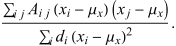
uniformly chosen edge and, when the corresponding variance is nonzero, the assortativity coefficient for
these attributes are
. The mean value at the end of a
uniformly chosen edge and, when the corresponding variance is nonzero, the assortativity coefficient for
these attributes are
 |  |  |
(1)
|
 |  |  |
(2)
|
Thus,  is the correlation coefficient of the
values at the two ends of a randomly oriented edge.
Positive, zero, and negative values indicate assortative, neutral, and disassortative
mixing, respectively (Newman 2003).
is the correlation coefficient of the
values at the two ends of a randomly oriented edge.
Positive, zero, and negative values indicate assortative, neutral, and disassortative
mixing, respectively (Newman 2003).
For an unlabeled simple graph, the standard choice is  .
The resulting
.
The resulting  is the degree assortativity coefficient: the Pearson correlation
coefficient of the vertex degrees at the two
ends of an edge (Newman 2002). The Wolfram
Language function GraphAssortativity[g]
returns
is the degree assortativity coefficient: the Pearson correlation
coefficient of the vertex degrees at the two
ends of an edge (Newman 2002). The Wolfram
Language function GraphAssortativity[g]
returns  .
This degree-based scalar is not the graph modularity
of
.
This degree-based scalar is not the graph modularity
of  .
Newman's equivalent formula uses the excess degrees
.
Newman's equivalent formula uses the excess degrees  (Newman 2003). Subtracting the same
constant at both ends does not change a correlation
coefficient.
(Newman 2003). Subtracting the same
constant at both ends does not change a correlation
coefficient.
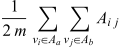
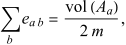
Categorical assortativity, also called discrete assortative mixing, is different. Let  be a set partition of the vertex
set. Its mixing matrix
be a set partition of the vertex
set. Its mixing matrix  and marginal fractions
  are
are
 |  |  |
(3)
|
 |  |  |
(4)
|
where  is the sum of the vertex degrees in
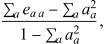
  . When its denominator is
nonzero, the categorical assortativity coefficient is
. When its denominator is
nonzero, the categorical assortativity coefficient is
 |  |  |
(5)
|
 |  |  |
(6)
|
Here,  is the number of edges with both endpoints in
  . For categorical data specified by a
set partition, GraphAssortativity[g,
partition, "Normalized" -> False] returns
. For categorical data specified by a
set partition, GraphAssortativity[g,
partition, "Normalized" -> False] returns  , exactly the graph modularity
score of the supplied set partition. The default
GraphAssortativity[g,
partition] returns
, exactly the graph modularity
score of the supplied set partition. The default
GraphAssortativity[g,
partition] returns  , dividing this score by its available maximum
  for the fixed marginal fractions
  .
.
