


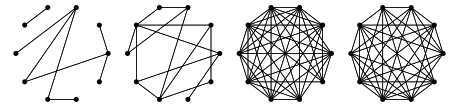
A random graph is a graph in which properties such as the number of graph vertices, graph
edges, and connections between them are determined in some random way. The graphs illustrated above are random graphs
on 10 vertices with edge probabilities distributed uniformly in  .
Erdős and Rényi (1960) showed that for many monotone-increasing graph properties of random graphs, graphs of a size slightly less than a certain threshold are very unlikely to have the property, whereas graphs with a few more graph edges are almost certain to have it. This is known as a phase transition (Janson et al. 2000, p. 103). Almost all graphs are connected and nonplanar (Skiena 1990, p. 156).
Pósa (1976) used the Pósa rotation-extension technique to show that, for a sufficiently large constant  , almost all graphs with
 edges have a Hamiltonian
cycle.
The Wolfram Language command RandomGraph[ n, m
 ] gives a pseudorandom graph with
 vertices
and
 edges.
He et al. (2026) reported bulk spectral universality for uniformly random simple  -regular graphs, for every
fixed integer
 . As
 through admissible values with
 even, the local eigenvalue
statistics of the adjacency matrix, rescaled
by the local spectral density at any fixed bulk energy, converge to the
 sine process associated
with the Gaussian orthogonal ensemble.
The result also includes consecutive-gap and fixed-energy correlation universality (He et al. 2026).
He et al. (2026) state that GPT-6 assisted proof development at the level of a coauthor, with the authors responsible for the entire paper.
For the model  ,
sampled uniformly from the simple graphs on
 labeled vertices
with
 edges, Coja-Oghlan et al. (2026) determined two
consecutive possible values of the chromatic number
when
 and
 . Let
 solve
 . Then
 is either
 or
 with high probability, where
 is the ceiling function.
More precisely, put
 and choose
 as in their theorem. The first value occurs with high probability whenever
 is not an integer and
 is outside
 |
where the union is over integers  .
For a sparse binomial random graph, Lin and Yang (2026) determined the minimum number of paths needed to partition its edges. If  and
 , then with high probability
 has a decomposition into exactly
 nonempty simple paths,
where
 counts its odd-degree vertices. Every such decomposition
needs at least this many paths, since each odd-degree graph
vertex must be an endpoint of a path. Here
 denotes little-o notation.
For every fixed  ,
the adjacency matrix of a graph sampled from
 is nonsingular with probability
at least
 for a constant
 (Liang et al. 2026). This follows from their exponential rank bound for real
symmetric random matrices.

 Edges." 24 Oct 2026.