

The graph circumference is the length of any longest cycle in a graph. Hamiltonian
graphs on  vertices therefore have circumference of
  .
.
For a cyclic graph  , the graph circumference is the polynomial
degree of the cycle polynomial
, the graph circumference is the polynomial
degree of the cycle polynomial  .
.
For a cyclic graph, the maximum element  of the detour matrix
over all adjacent vertices
of the detour matrix
over all adjacent vertices  is one smaller than the circumference.
The graph circumference of a self-complementary graph is either  (i.e., the graph is Hamiltonian),
 ,
or
,
or  (Furrigia 1999, p. 51).
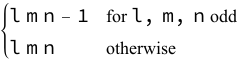
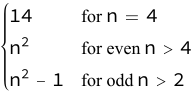
Circumferences of graphs for various classes of nonhamiltonian graphs are summarized in the table below.
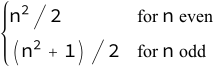
 -
-
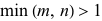
 for
for 
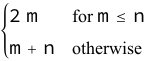
 -
-
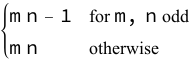



 -
-


 -
-
Ma and Zhao (2026) proved that every finite connected vertex-transitive graph on  vertices has circumference
at least
vertices has circumference
at least  for an absolute constant
  , a lower bound linear in the number of vertices.
For all sufficiently large vertex degrees
, a lower bound linear in the number of vertices.
For all sufficiently large vertex degrees  , the lower bound is
  . These results give progress toward the Lovász
conjecture without establishing Hamiltonicity.
. These results give progress toward the Lovász
conjecture without establishing Hamiltonicity.
