

Granger causality from a time series  to a time series
  , relative to a specified information set, is the property
that the past of
, relative to a specified information set, is the property
that the past of  improves prediction of
  beyond the information already contained in the past of
 and any conditioning variables. More
formally, let
and any conditioning variables. More
formally, let  be the sigma-algebra generated by the past of
  and conditioning variables
  , and let
  additionally contain the past of
  . Then
  does not Granger-cause
  if
if
 |
for every  .
.
In a linear regression containing  lags, or past values, of
each series,
lags, or past values, of
each series,
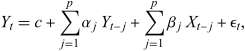 |
the corresponding null hypothesis is  . Granger causality in both directions is
sometimes called feedback.
. Granger causality in both directions is
sometimes called feedback.
The result of a Granger-causality test depends on the selected lags. The lag order  is the number of past time steps included. The result also depends on the sampling
interval, the conditioning variables, and the assumptions used to make the series
suitable for prediction. Granger causality is predictive rather than structural or
interventional causality: omitted variables, aggregation, or common drivers can produce
predictive precedence without a direct causal mechanism.
is the number of past time steps included. The result also depends on the sampling
interval, the conditioning variables, and the assumptions used to make the series
suitable for prediction. Granger causality is predictive rather than structural or
interventional causality: omitted variables, aggregation, or common drivers can produce
predictive precedence without a direct causal mechanism.
