

An autoregressive model of order  , denoted
  , is a time series model
in which the current value is a linear function
of the preceding
, is a time series model
in which the current value is a linear function
of the preceding  values and an innovation,
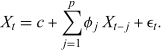 |
(1)
|
The innovations are commonly assumed to be uncorrelated, to have population mean zero, and to have constant variance. The associated autoregressive polynomial, also called the characteristic polynomial, is
 |
(2)
|
The model has a solution that is both a causal time series and a stationary time series
when every root of  lies outside the unit circle.
Causality means that
lies outside the unit circle.
Causality means that  can then be expressed using only present and past innovations,
rather than future innovations.
can then be expressed using only present and past innovations,
rather than future innovations.
For the first-order  model
model
 |
(3)
|
the process is a stationary time series when  .
In that case, the population mean is
.
In that case, the population mean is  and the autocorrelation
at lag
and the autocorrelation
at lag  is
is
 |
(4)
|
Autoregressive models also arise in the maximum entropy method of spectral estimation.
