

The Golub-Welsch algorithm constructs a Gaussian quadrature rule from the eigenvalues and eigenvectors
of a Jacobi matrix. Let  be a finite positive measure
on the real line, with finite moments through order
 and a positive definite polynomial inner product through degree
 , where
 is a positive integer.
Form the leading
 Jacobi matrix
 from its orthogonal
polynomials. The eigenvalues
 of
 are the quadrature nodes. For corresponding real unit eigenvectors
 , the weights
are
 |
where  is the total mass. The rule
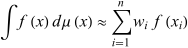 |
is exact for polynomials of polynomial degree at most  (Golub and Welsch 1969).
The Jacobi matrix is a real symmetric matrix and a tridiagonal matrix, so its spectrum can be computed with specialized symmetric tridiagonal eigensolvers. Modifying its terminal entries similarly constructs Radau quadrature and Lobatto quadrature rules with prescribed endpoints (Golub 1973).
