

The German tank problem is the problem of estimating the unknown positive integer upper endpoint  of the consecutive serial numbers 1, 2, ...,
 from a simple random sample
of
 distinct numbers drawn without replacement, where
 . Every
 -element subset is assumed equally
likely. The name refers to the use of serial-number analysis to estimate German military
production during World War II (Ruggles and Brodie 1947).
The German tank problem should not be confused with the quarter-tank problem, which concerns the geometry of a partially filled cylindrical tank.
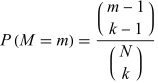
Let  be the largest observed serial number. This order
statistic has probability mass function
 |
(1)
|
for  ,
and 0 otherwise, since exactly
 of the
 possible samples have maximum
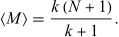
 . Its expectation
value is
 |
(2)
|
The maximum likelihood estimator of  is
 ,
but this underestimates
 on average when
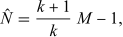
 . Correcting the estimator
bias gives the minimum variance
unbiased estimator
 |
(3)
|
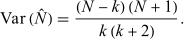
whose variance is
 |
(4)
|
These formulas apply to sampling without replacement, not to independent draws with replacement (Goodman 1952, Clark et al. 2021).
For example, observing the three serial numbers 3, 14, and 15 gives  and
 , so the minimum
variance unbiased estimator gives
 , whereas the maximum
likelihood estimator gives 15.
