


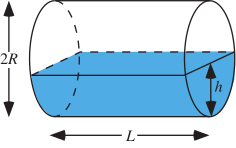
The quarter-tank problem asks for the height above the bottom of a horizontal cylinder (such as a cylindrical
gas tank) to which it must be filled for it to be one quarter full. It is solved
by plugging  (one quarter of the area of a full circle)
into the equation for the area
of a circular segment of radius
 ,
 |
(1)
|
where  .
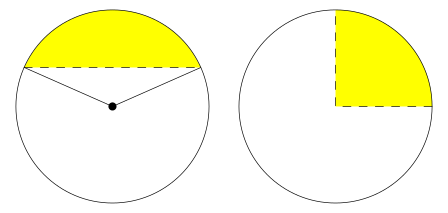
This gives equality between the two shaded areas in the above figure, resulting in
 |
(2)
|
where  and
 is the radius of the circle
or cylinder. The unique solution with
 is approximately
 (OEIS A133742),
corresponding to
 .
The solution can also be expressed in terms of the Dottie number  ,
defined by
 .
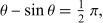
The central angle
 of the quarter-filled circular
segment satisfies
 |
(3)
|
so  .
The corresponding height is therefore given by
 |  |  |
(4)
|
 |  |  |
(5)
|
(M. J. Rodman, pers. comm., July 20, 2023).
The quarter-tank problem should not be confused with the German tank problem, which concerns statistical estimation from serial numbers.
