


The discrete uniform distribution assigns equal probability to each element of a finite nonempty set. It is also known as the "equally likely
outcomes" distribution. Let  have
 elements, where
 is a positive integer,
and let
 be the event consisting of its
 th element. Then
 |  |  |
(1)
|
 |  |  |
(2)
|
 |  |  |
(3)
|
 |  |  |
(4)
|
so using  gives
 |
(5)
|
Restricting the set  to the set of positive integers 1, 2, ...,
 , the probability distribution function and cumulative distributions
function for this discrete uniform distribution are therefore
 |  |  |
(6)
|
 |  |  |
(7)
|
for  ,
...,
 .
The discrete uniform distribution is implemented in the Wolfram Language as DiscreteUniformDistribution[ 1,
N
 ]
for
 .
Its moment-generating function is
 |  |  |
(8)
|
 |  |  |
(9)
|
 |  |  |
(10)
|
 |  |  |
(11)
|
At  ,
use the limiting value
 . The moments about 0 are
 |
(12)
|
so
 |  |  |
(13)
|
 |  |  |
(14)
|
 |  |  |
(15)
|
 |  |  |
(16)
|
and the moments about the mean are
 |  |  |
(17)
|
 |  |  |
(18)
|
 |  |  |
(19)
|
The mean, variance, skewness, and kurtosis excess are
 |  |  |
(20)
|
 |  |  |
(21)
|
 |  |  |
(22)
|
 |  |  |
(23)
|
For  ,
the variance is zero and the skewness
and kurtosis excess are undefined. The displayed
formulas for these two standardized quantities require
 .
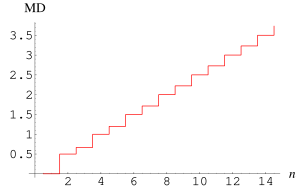
The mean deviation for the discrete uniform distribution on 1, 2, ...,  is given by
 |
(24)
|
To do the sum, consider separately the cases of  odd and
 even. For
 odd,
 |  |  |
(25)
|
 |  |  |
(26)
|
 |  |  |
(27)
|
 |  |  |
(28)
|
Similarly, for  even,
 |  |  |
(29)
|
 |  |  |
(30)
|
 |  |  |
(31)
|
 |  |  |
(32)
|
The complete solution is therefore
 |
(33)
|
For  ,
2, ..., the first few values are 0, 1/2, 2/3, 1, 6/5, 3/2, 12/7, ... (OEIS A086111
and A086112).
