


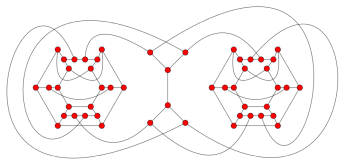
The Georges-Kelmans graph, also called the Georges graph, is the 50-vertex bicubic nonhamiltonian graph illustrated
above, with cyclic edge connectivity at
least 4. The graph was originally constructed by Kel'mans
(1988), though rediscovered independently by Georges (1989) as the smallest member
of an infinite family of bicubic
nonhamiltonian graphs that are k-connected
with  . Gropp (1990, 1993) subsequently stated that the
two graphs are isomorphic,
and Kel'mans (1994) later gave a fuller account of his construction. Grünbaum
(2009, p. 317) regarded the identification as unjustified from the published
accounts, but the direct reconstruction given below confirms the graph
isomorphism. Brinkmann et al. (2022) adopted the combined name Georges-Kelmans
graph, credited Kel'mans and Georges with independent discovery, and proved that
the graph is the smallest bicubic
nonhamiltonian graph that is k-connected
with
 . Bondy and Murty (2008, p. 483) call it the
Kelmans-Georges graph.
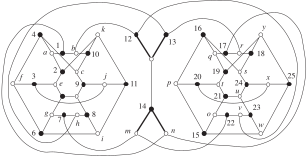
The construction from two copies of a modification of the 18-vertex member of the Ellingham-Horton graphs is illustrated above (Grünbaum 2006; Grünbaum 2009, pp. 310-311).
The Georges-Kelmans graph has girth 6 and is the Levi graph of the  Georges configuration, for which Grünbaum
(2009, pp. 311-316) gave a geometric realization
and Kocay (2010) subsequently gave a geometric
realization with exact rational homogeneous
coordinates.
The Georges-Kelmans graph has graph crossing number 12.
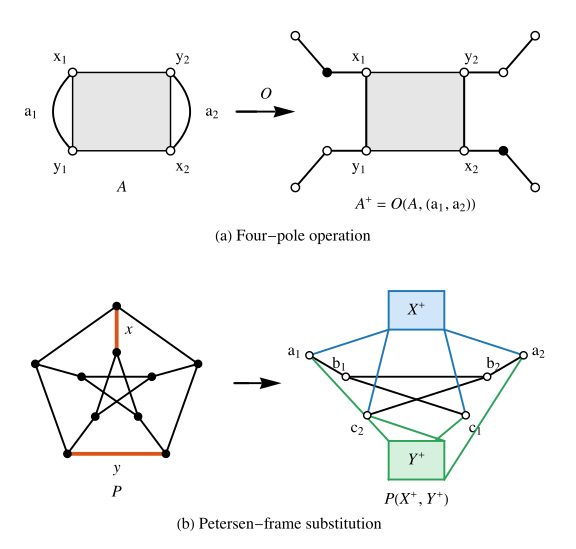
Kel'mans's two basic operations are shown above, reproducing his Figures 1 and 2. Given a bicubic graph  and two distinct edges
 and
 , the operation
 replaces each selected graph
edge by a three-edge graph
path and attaches a pendant edge to each of the
two new internal vertices. The result is a graph
multipole
 with four poles, represented here by vertices of
vertex degree 1. The second operation deletes two
specified edges
 and
 from the Petersen graph
and replaces them by graph multipoles
 and
 with four poles each, attached as shown, to form the bicubic graph
 .
Let  be the multigraph on two vertices
with three parallel edges
 ,
 , and
 , and let
 , with
 designated the middle graph
edge. Form
 from two copies of
 whose middle edges are denoted
 and
 , and then set
 . Finally, form
 , where
 and
 are two copies of
 . This gives Kel'mans's 50-vertex graph
 .
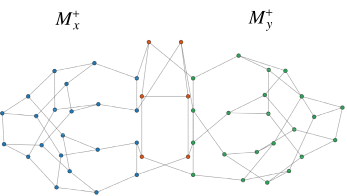
The graph  is illustrated above, with the two copies of
 shown in blue and green and the six remaining vertices
of the Petersen framework shown in orange. Direct computation shows that
 is isomorphic to the
Georges-Kelmans graph.

The three panels above redraw Figure 18.12 of Bondy and Murty (2008, p. 483). They present this construction in terms of a Petersen
graph and an intermediate 18-vertex bicubic
graph  . Their Figure 18.12b shows
 in a Petersen-like drawing, while Figure 18.12c redraws
the same graph to make the substitution clearer. In the
notation above,
 , and their marked edges
 and
 are the middle edges
 and
 of the two copies of
 . A Hamiltonian
cycle in
 containing both
 and
 would reduce to a Hamiltonian cycle in the Petersen graph, which is impossible. The restriction
is on using both marked edges, not on the existence
of a Hamiltonian cycle in
 itself.
The final step substitutes two copies of the redrawn  into the Petersen graph
using the two marked edges as attachment sites. Each
marked edge is subdivided
twice, and the four new vertices are attached to
the remaining Petersen framework as in the operation
 above. Each copy thus contributes 22 vertices,
while the framework contributes six, giving 50 vertices
in all.
To see why the resulting graph is a nonhamiltonian graph, suppose it had a Hamiltonian cycle.
The Hamiltonian cycle would use either two or
four attachment edges at each substituted copy. If
it used two, they would have to belong to different marked edges.
If it used four, the two paths through the copy would
have to pair the attachment vertices on each marked
edge separately. Otherwise, restoring the marked edges would produce a Hamiltonian
cycle in  through both
 and
 . The permitted traversals can therefore be replaced
by traversals through the two removed Petersen vertices,
giving a Hamiltonian cycle in the Petersen
graph and hence a contradiction (Bondy and
Murty 2008, Exercise 18.2.5).
It is implemented in the Wolfram Language as GraphData["GeorgesGraph"].

 with No Hamiltonian Circuit." Bull. Inst. Combin.
Appl. 46, 15-26, 2006.Grünbaum, B.