


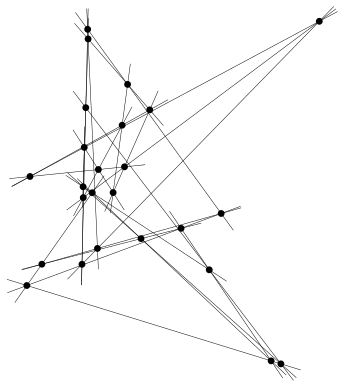
The Georges configuration is a geometric  configuration whose Levi graph is the Georges-Kelmans
graph. It therefore consists of 25 points and 25 lines, with three points on each
line and three lines through each
point.
Grünbaum constructed the configuration to disprove the conjecture that every 3-connected  configuration admits a Hamiltonian
multilateral (Grünbaum 2006; Grünbaum 2009, pp. 311-316). A Hamiltonian
multilateral would correspond to a Hamiltonian cycle
in the Levi graph, so the Georges configuration admits
no such multilateral.
Grünbaum's geometric realization uses a construction due to Steinitz (1910). Starting with freely chosen points, the remaining points and lines are obtained successively by joining two known points or intersecting two known lines. In the final step, point 25 must be the common intersection of three previously determined lines. Grünbaum exhibited choices for which the intersection of two of these lines lies on opposite sides of the third, so continuity guarantees a choice yielding the required triple intersection.
Kocay (2010) subsequently gave a rational coordinatization. He temporarily removed the incidence between point 2 and line
42 to obtain a determining set and construction sequence for the remaining incidences.
After expressing the point and line
coordinates in terms of the homogeneous coordinates of point
2, he restored the omitted incidence by imposing  . This condition defines a cubic
curve. The tangent at a known degenerate rational
point meets the curve at another rational point, which
gives rational homogeneous coordinates
satisfying all intended incidences, with no unintended incidences or coincident points or lines.
The Georges configuration is a self-dual configuration.

 with No Hamiltonian Circuit."
Bull. Inst. Combin. Appl. 46, 15-26, 2006.Grünbaum,
B.