


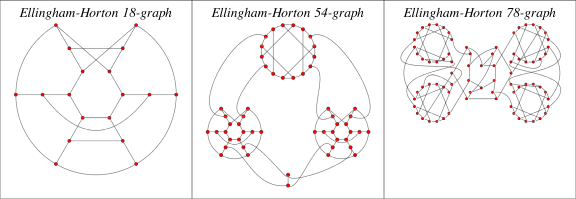
The term "Ellingham-Horton graphs" is used in this work for three graphs associated with Ellingham and Horton. The smallest has 18 vertices, while two larger graphs on 54 and 78 nodes are examples of 3-connected bicubic nonhamiltonian graphs, and therefore provide counterexamples to the Tutte bicubic graph conjecture.
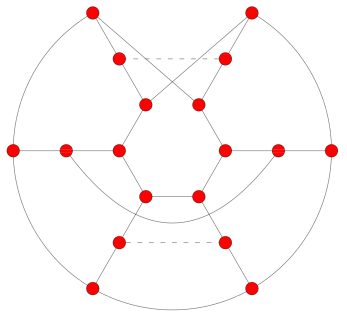
Ellingham and Horton (1983) constructed the 54-Ellingham-Horton graph using two copies of the 18-node bicubic
graph  illustrated above, deleting the two dashed edges from
each and rejoining the resulting vertices of degree
2 to the other components. No Hamiltonian
cycle in
 contains both specified edges. Georges (1989) used
 as the basis of his construction of the Georges-Kelmans
graph. Each specified edge is subdivided
twice in the construction, and two copies of the resulting graph
are combined (Grünbaum 2009, pp. 310-311). However, Georges's published
drawing of graph
 omits one of the two specified edges
(Grünbaum 2009, p. 317).
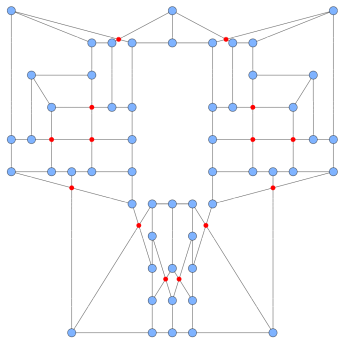
The 54-Ellingham-Horton graph has graph crossing number and rectilinear crossing number 14, illustrated above in a bilaterally symmetric minimal straight line drawing (E. Weisstein, Oct. 20, 2025). The 78-Ellingham-Horton graph has graph crossing number 18 (E. Weisstein, Oct. 1, 2026). Its rectilinear crossing number is at most 25 (E. Weisstein, Oct. 20, 2025).
