


The figure eight knot complement is the knot complement  of the figure eight knot
 in the 3-sphere
 . It admits a complete finite-volume Riemannian
metric of constant sectional curvature
 , making the figure
eight knot a hyperbolic knot.
 |
|
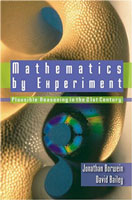
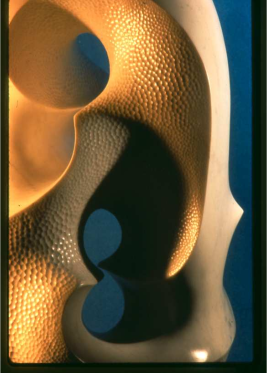
Helaman Ferguson's sculpture "Figure-Eight Complement II" depicts a thickening of a punctured torus bounded by the figure eight knot, rather than the entire three-dimensional knot complement (Borwein and Bailey 2003, pp. 54-55, color plate IV, and front cover; Bailey et al. 2007, p. 37; photograph courtesy of Helaman Ferguson). This Seifert surface is topologically a torus with an open disk removed. Its thickening has a closed genus-two boundary on which the figure eight knot separates the two copies of the Seifert surface. Ferguson's "Figure-Eight Complement III" instead thickens a punctured Klein bottle (Edmonds).

The plotted model uses a disk with two full-twist bands of opposite handedness, attached along alternating pairs of boundary arcs (Baker 2004, p. 143). The red curve traces the figure eight knot along the boundary of the thickening.
Ferguson has carved the BBP-type formula for the hyperbolic volume of the knot complement (discussed below) on both figure eight knot complement sculptures commissioned by the Clay Mathematics Institute (Borwein and Bailey 2003, p. 56; Bailey et al. 2007, pp. 36-38).
The hyperbolic volume of the knot complement of the figure eight knot is approximately given by
 |
(1)
|
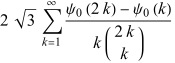
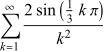
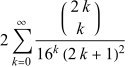
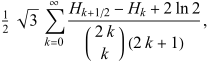
(OEIS A091518). Exact expressions are given by the infinite sums
 |  |  |
(2)
|
 |  |  |
(3)
|
 |  |  |
(4)
|
 |  |  |
(5)
|
 |  |  |
(6)
|
where  is a harmonic number.
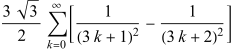
 has a variety of BBP-type formulas including
 |  |  |
(7)
|
 |  |  |
(8)
|
 |  |  |
(9)
|
 |  |  |
(10)
|
 |  |  |
(11)
|
with additional identities for coefficients of  of the form
 (E. W. Weisstein, Sep. 30, 2007). Higher-order
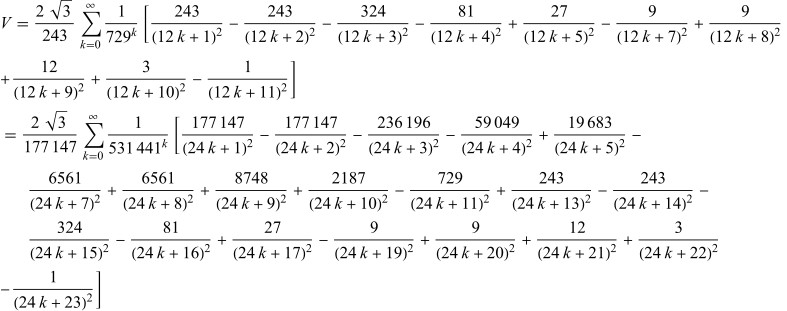
identities are
 |
(12)
|
(E. W. Weisstein, Aug. 11, 2008).
Additional classes of identities are given by
 |  |  |
(13)
|
 |  |  |
(14)
|
with additional identities for coefficients of  of the form
 (E. W. Weisstein, Sep. 30, 2007). Another
BBP-type formula is given by
 |  |  |
(15)
|
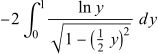
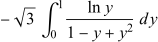
 is also given by the integrals
 |  |  |
(16)
|
 |  |  |
(17)
|
 |  |  |
(18)
|
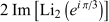
and the analytic expressions
 |  |  |
(19)
|
 |  |  |
(20)
|
 |  |  |
(21)
|
 |  |  |
(22)
|
 |  |  |
(23)
|
 |  |  |
(24)
|
 |  |  |
(25)
|
 |  |  |
(26)
|
(Broadhurst 1999; Borwein and Bailey 2003, pp. 54 and 88-92; Bailey et al. 2007, pp. 36-38 and 265-266), where  is a generalized
hypergeometric function,
 is the trigamma function,
 is the dilogarithm and
 is Clausen's integral.

 Primitives of Algebras of the Sixth Root of Unity."
Eur. Phys. J. C 8, 311-333, 1999.