


A hyperbolic knot is a knot that has a complement that admits a complete finite-volume metric of constant curvature  . All hyperbolic knots are prime
knots (Hoste et al. 1998).
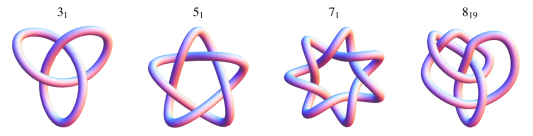
A prime knot on 10 or fewer crossings can be tested in the Wolfram Language to see if it is hyperbolic using KnotData[knot, "Hyperbolic"].
Of the prime knots with 16 or fewer crossings, all but 32 are hyperbolic. Of these 32, 12 are torus knots and the remaining 20 are satellites
of the trefoil knot (Hoste et al. 1998). The
nonhyperbolic knots with nine or fewer crossings are all torus knots, including  (the
 -torus knot),
 ,
 ,
 (the
 -torus knot), and
 , the first few of which are illustrated above.
The following table counts nonhyperbolic and hyperbolic prime knots with  crossings, starting at
 ,
with orientation ignored and mirror images identified
(Hoste et al. 1998).
| type | OEIS | counts |
| torus | A051764 | 1, 0, 1, 0, 1, 1, 1, 1, 1, 0, 1, 1, 2, 1, ... |
| satellite | A051765 | 0, 0, 0, 0, 0, 0, 0, 0, 0, 0, 2, 2, 6, 10, ... |
| nonhyperbolic | A052407 | 1, 0, 1, 0, 1, 1, 1, 1, 1, 0, 3, 3, 8, 11, ... |
| hyperbolic | A052408 | 0, 1, 1, 3, 6, 20, 48, 164, 551, 2176, 9985, 46969, 253285, 1388694, ... |
The hyperbolic volume does not completely distinguish hyperbolic knots. For example,  and the knot
 have the same hyperbolic
volume (Adams 1994, p. 124).
Cao and Meyerhoff (2001) proved that the figure eight knot has the smallest hyperbolic volume,
2.0298.... The second-smallest distinct hyperbolic
volume is 2.8281220883..., attained by  and
 (McCoy 2023, Theorem 2.1).
Mutant knots have the same hyperbolic knot volume.
The knot symmetry group of a hyperbolic knot must be either a finite cyclic group or a finite dihedral group (Riley 1979, Kodama and Sakuma 1992, Hoste et al. 1998).

 -Manifolds of Minimum Volume." Invent. Math. 146,
451-478, 2001.Hoste, J.; Thistlethwaite, M.; and Weeks, J. "The
First
 Knots." Math. Intell. 20, 33-48, Fall 1998.Kodama
K. and Sakuma, M. "Symmetry Groups of Prime Knots Up to 10 Crossings."
In
 -Pretzel Knot." Canad. Math. Bull. 66,
937-950, 2023.