

An exponential sum is a finite sum of complex numbers of the form
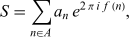 |
where  is a finite index set,
 are complex
weights, and
 is a real-valued phase (McGehee et al. 1981). The unweighted case has
 . Although every summand then has absolute
value 1, cancellation can make
 much smaller than
 .
For a positive integer  and an integer
 , the sum of
 over
 is zero when
 does not divide
 , and is
 when
 divides
 . Littlewood's
exponential sum problem concerns the average absolute
value of sums with distinct integer frequencies.
Over a finite field, the number of distinct values of an exponential sum can be studied as its parameters vary. Helleseth's
three-valued conjecture concerns the sums built from  when
 is a permutation
and the extension degree over the prime
field is a power of 2 (Helleseth 1976).

 -Norm of Exponential Sums." Ann. Math. 113,
613-618, 1981.