Littlewood's exponential sum problem asks whether there is an absolute constant set integers ,
Here natural logarithm . The problem concerns
the integral of the absolute value of an exponential
sum , rather than its value at a single point (Hardy and Littlewood 1948).
McGehee et al. (1981) and Konyagin (1982) independently proved the assertion. It is distinct from Littlewood conjecture
in simultaneous rational approximation.
This is problem 512 in the Erdős
problems collection (Bloom 2026).
See also Erdős Problems ,
Exponential
Sum
Explore with Wolfram|Alpha
References Bloom, T. F. "Erdős Problem 512." Accessed Oct. 26, 2026. https://www.erdosproblems.com/512 . Hardy,
G. H. and Littlewood, J. E. "A New Proof of a Theorem on Rearrangements."
J. London Math. Soc. 23 , 163-168, 1948. https://doi.org/10.1112/jlms/s1-23.3.163 . Konyagin,
S. V. "On a Problem of Littlewood." Math. USSR-Izv. 18 ,
205-225, 1982. https://doi.org/10.1070/IM1982v018n02ABEH001386 . McGehee,
O. C.; Pigno, L.; and Smith, B. "Hardy's Inequality and the Ann. Math. 113 ,
613-618, 1981. https://doi.org/10.2307/2007000 .
Cite this as:
Weisstein, Eric W. "Littlewood's Exponential Sum Problem." From MathWorld https://mathworld.wolfram.com/LittlewoodsExponentialSumProblem.html
Subject classifications


 such that, for every set
 of
 distinct integers,
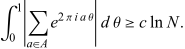
 is the natural logarithm. The problem concerns
the integral of the absolute value of an exponential
sum, rather than its value at a single point (Hardy and Littlewood 1948).

 -Norm of Exponential Sums." Ann. Math. 113,
613-618, 1981.