

Euler's equations of rigid body motion are ordinary differential equations for the components  ,
 , and
 of angular velocity
in a frame attached to a rigid body. Choose the principal
axes of the moment of inertia about its center of mass, and let
 ,
 , and
 be the corresponding positive
moments. If
 are the components of the applied torque about the center of mass, then
 |  |  |
(1)
|
 |  |  |
(2)
|
 |  |  |
(3)
|
The same equations apply to rotation about a fixed point when the moments and torques are taken about that point (Peraire and Widnall 2009, pp. 1-3).
For torque-free motion, the rotational kinetic energy 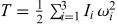 and the squared magnitude of
the angular momentum
 are integrals
of motion. These invariants and the linear
stability of rotation about each principal axis
give the intermediate axis theorem.
