

The intermediate axis theorem states that torque-free rotation of a rigid body about a principal axis with the largest or smallest moment of inertia is stable, whereas rotation about the intermediate principal axis is unstable. It is also called the tennis racket theorem (Peraire and Widnall 2009).
Suppose the principal moments satisfy  . Linearizing Euler's
equations of rigid body motion about the steady rotation
 , with
 , gives a perturbation
 satisfying
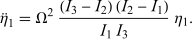 |
The coefficient is positive, so some perturbations grow exponentially. Linearization about the other two principal axes instead gives a negative coefficient and oscillatory perturbations. The conserved kinetic energy and angular momentum also establish stability of the extreme-axis rotations in the nonlinear torque-free equations.
The hypotheses of distinct principal moments and absence of torque are important. In particular, dissipation or an applied torque can change the stability conclusions.
