

An expansion coefficient is a scalar multiplying one of the vectors or functions
in a linear combination or series
expansion (Liu 2005, p. 21). For an ordered vector
basis  of a finite-dimensional vector space, every vector
 has a unique expansion
 |
(1)
|
where the  are expansion coefficients in the base field (Axler 2024,
p. 40). The coefficients depend on the chosen vector
basis. For example, the polynomial
 has coefficients
 in the vector basis
 and
 in the vector basis
 .
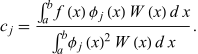
In an inner product space, take the inner product to be linear in its first argument. For an orthogonal basis, the coefficients are
 |
(2)
|
For an orthonormal basis, this simplifies to  (Axler 2024, pp. 199-200). For real orthogonal
functions on an interval
 with a positive weighting function
 , the formula becomes
 |
(3)
|
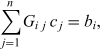
For a general vector basis, taking inner products gives the linear system of equations
 |
(4)
|
where  and
 .
The Gram matrix
 is positive definite
because the basis vectors are linearly
independent. Hence
 .
Fourier coefficients are expansion coefficients for trigonometric functions or complex exponential functions. A Taylor series uses expansion coefficients for powers about its expansion point. For infinite series expansions, convergence must also be specified, as in a generalized Fourier series. A discrete variable representation changes from expansion coefficients in a vector basis of functions to coefficients determined by weighted values at nodes.
