

Dirichlet regularization assigns a value to a series  by introducing the Dirichlet series
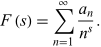 |
If this series converges in a right half-plane and has an analytic continuation that is
regular at  ,
its Dirichlet-regularized value is defined to be
,
its Dirichlet-regularized value is defined to be  . If
. If  has a pole at 0, a separately stated
finite-part prescription may instead use the constant term of its Laurent
series.
has a pole at 0, a separately stated
finite-part prescription may instead use the constant term of its Laurent
series.
Summability methods are commonly labeled in parentheses after the assigned value. Standard examples are  for Abel summability,
 for Cesàro summability, and
  for Borel summability
(Hardy 1991, pp. 6-8; NIST DLMF, §1.15(i)). In this work,
for Borel summability
(Hardy 1991, pp. 6-8; NIST DLMF, §1.15(i)). In this work,  similarly denotes Dirichlet regularization. For example,
taking
similarly denotes Dirichlet regularization. For example,
taking  gives
gives  and
and
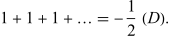 |
Since  ,
the displayed value is a regularized value, not the limit of the ordinary partial
sums. Although Dirichlet regularization is a type of regularized
sum, it differs from the related zeta-regularized
sum of a positive sequence, which evaluates a spectral
zeta function at
,
the displayed value is a regularized value, not the limit of the ordinary partial
sums. Although Dirichlet regularization is a type of regularized
sum, it differs from the related zeta-regularized
sum of a positive sequence, which evaluates a spectral
zeta function at  .
.
