

A Cesàro sum is a limit obtained by averaging the partial sums of a series.
Let  be its partial
sums, and define their arithmetic means
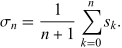 |
(1)
|
If
 |
(2)
|
then the series is Cesàro summable to  ,
and the method of assigning this value is called Cesàro summation. Every convergent series is Cesàro summable to
its ordinary sum, while some divergent
series are Cesàro summable. For example,
 has Cesàro sum
 .
This is the order-1 method, denoted  . For a positive
integer
 , the higher-order means are
 |
(3)
|
where the weights are binomial coefficients (Hardy 1949, p. 96). If  , the series
is called Cesàro summable of order
 to
 . For integer
 , these means differ from repeatedly taking arithmetic means, but give the same summability and
sum as Hölder
regularization of order
 (Hardy 1949, p. 103).
For  , the series
 is not summable
 because the even and odd subsequences of
 tend to
 and 0. Its order-2 means are
 |  |  |
(4)
|
 |  |  |
(5)
|
where  is a nonnegative
integer. Both tend to
 , so the series
is summable
 . Every series summable
 for a positive
integer
 has an Abel-regularized sum equal to its
 sum (Hardy
1949, p. 108).
