


A coprime graph is a graph defined by making two objects adjacent when a pair of associated positive integers is relatively prime. The term is not completely standardized, and the associated integers depend on context.
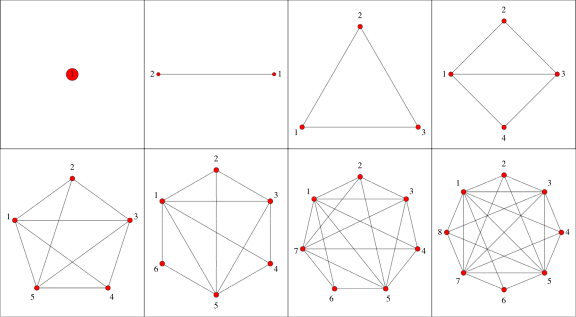
A common number-theoretic version, the coprime graph of integers, has vertices 1, 2, ...,  ,
with two distinct vertices
,
with two distinct vertices  and
and  adjacent iff
  , i.e., iff
  and
and  are relatively prime (Erdős
and Sárközy 1997, Sárközy 1999, Sander and Sander 2009, Banerjee
2026). This graph is denoted
are relatively prime (Erdős
and Sárközy 1997, Sárközy 1999, Sander and Sander 2009, Banerjee
2026). This graph is denoted  by Banerjee (2026), while the House of Graphs database
uses labels such as
by Banerjee (2026), while the House of Graphs database
uses labels such as  for the corresponding graph on seven vertices.
Every coprime graph of integers is a traceable graph: for  this is immediate, while for
  the vertex sequence 1, 2, ...,
  gives a Hamiltonian path,
since consecutive integers are relatively
prime. For
gives a Hamiltonian path,
since consecutive integers are relatively
prime. For  ,
the additional edge joining
,
the additional edge joining  to 1 closes this path to a Hamiltonian cycle, since
  . The case
  is the Hamiltonian graph
  , while
  is nonhamiltonian; hence
  is the only nonhamiltonian coprime graph of integers.
Direct computation of the stable coloring produced by color refinement shows
that  is amenable, and hence has Weisfeiler-Leman
dimension 1, for
is amenable, and hence has Weisfeiler-Leman
dimension 1, for  and again for
  .
For
.
For  ,
it is not amenable, so its Weisfeiler-Leman
dimension is greater than 1. Thus amenability
is not monotone in
,
it is not amenable, so its Weisfeiler-Leman
dimension is greater than 1. Thus amenability
is not monotone in  for this graph family.
At
for this graph family.
At  , the stable cells
  ,
,  , and
, and  are pairwise anisotropically related and form a triangle
graph in the anisotropic cell graph. This violates
the forest condition in the exact characterization of
amenable graphs (Arvind et al. 2017) and
certifies that
are pairwise anisotropically related and form a triangle
graph in the anisotropic cell graph. This violates
the forest condition in the exact characterization of
amenable graphs (Arvind et al. 2017) and
certifies that  is not amenable.
The named instances among small coprime graphs of integers are summarized in the following table.





A shifted integer variant, the  -coprime graph of order
  , has vertex
set
, has vertex
set  and the same relative-primality adjacency rule
(Bani Mostafa and Ghorbani 2021).
and the same relative-primality adjacency rule
(Bani Mostafa and Ghorbani 2021).
This adjacency convention is complementary to that used for an Erdős graph, whose Erdős sequence gives associated integers that make two vertices adjacent when the corresponding integers are not relatively prime.
In group theory, Ma, Wei, and Yang (2014) define the coprime graph of a finite group  to have vertex set
  , with distinct elements
  and
and  adjacent iff
  , where
  denotes the order of
  . This usage is also followed, for example,
for groups of integers modulo
. This usage is also followed, for example,
for groups of integers modulo
 and their subgroups
by Juliana et al. (2020). A related but different subgroup
version has as vertices the proper
subgroups of a group, with two vertices adjacent iff the corresponding
subgroup orders are relatively prime (Rajkumar and Devi 2015). Yet another
variant, the prime coprime graph of a finite group,
joins two group elements when
and their subgroups
by Juliana et al. (2020). A related but different subgroup
version has as vertices the proper
subgroups of a group, with two vertices adjacent iff the corresponding
subgroup orders are relatively prime (Rajkumar and Devi 2015). Yet another
variant, the prime coprime graph of a finite group,
joins two group elements when  is either 1 or a prime
(Banerjee and Adhikari 2022).
is either 1 or a prime
(Banerjee and Adhikari 2022).
Thus, when the phrase "coprime graph" is used without qualification, the intended vertex set and the integers whose coprimality is being tested should be specified.

 Group and Its Subgroups." J. Fundamental Math. Appl. 3,
15-18, 2020.
Group and Its Subgroups." J. Fundamental Math. Appl. 3,
15-18, 2020.