


The Weisfeiler-Leman dimension  of a finite graph
  ,
sometimes known as the WL dimension, is the smallest positive
integer
,
sometimes known as the WL dimension, is the smallest positive
integer  such that the
  -dimensional Weisfeiler-Leman
algorithm distinguishes
-dimensional Weisfeiler-Leman
algorithm distinguishes  from every graph not isomorphic
to
from every graph not isomorphic
to  (Grohe 2017).
The Weisfeiler-Leman dimension of a graph  with vertex count
  satisfies
 |
(Kiefer 2020, p. 37). The only graph with  is the singleton
graph
is the singleton
graph 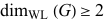 .
.
For a nonempty graph  , let
, let  range over its connected
components, and set
range over its connected
components, and set  . Any component
requiring
. Any component
requiring  dimensions gives the lower bound
  . Conversely, when
  , the
, the  -dimensional Weisfeiler-Leman
algorithm detects whether vertices lie in the
same connected component and retains the
-dimensional Weisfeiler-Leman
algorithm detects whether vertices lie in the
same connected component and retains the  -dimensional
information within each component. It can
therefore identify
-dimensional
information within each component. It can
therefore identify  once
once  is at least both 2 and
  . Thus
 |
In particular,  equals the maximum component dimension when that maximum
is at least 2 (Kiefer et al. 2019, Section 4).
equals the maximum component dimension when that maximum
is at least 2 (Kiefer et al. 2019, Section 4).
The condition that the maximum component dimension is at least 2 is essential. The stronger claim (Schweitzer 2018) that the
equality holds whenever  , even if every component
has dimension 1 is incorrect. Indeed,
, even if every component
has dimension 1 is incorrect. Indeed,  while
while  . Color refinement
does not distinguish
. Color refinement
does not distinguish  from
from  . Any graph it does not distinguish
from
. Any graph it does not distinguish
from  has six vertices of vertex
degree 2 and is therefore either
has six vertices of vertex
degree 2 and is therefore either  or
or  , and the two-dimensional Weisfeiler-Leman
algorithm distinguishes these two graphs by the numbers
of common neighbors of nonadjacent vertices.
, and the two-dimensional Weisfeiler-Leman
algorithm distinguishes these two graphs by the numbers
of common neighbors of nonadjacent vertices.
A finite graph  has Weisfeiler-Leman dimension 1 iff color refinement, the one-dimensional Weisfeiler-Leman
algorithm, distinguishes
has Weisfeiler-Leman dimension 1 iff color refinement, the one-dimensional Weisfeiler-Leman
algorithm, distinguishes  from every graph not isomorphic
to
from every graph not isomorphic
to  (Arvind et al. 2017). Such a graph is amenable.
The characterization is structural rather than a short list of familiar graph families. In the formulation of Arvind et al. (2017,
Theorem 9), the stable color classes produced by color
refinement are regarded as cells. Each cell induces an empty
graph, a complete graph, a perfect
matching or its graph complement, or the
cycle graph  . Between two cells, the induced bipartite
graph is an empty graph, a complete
bipartite graph, a graph disjoint union
of isomorphic star
graphs whose centers all lie in one cell, or the bipartite
complement of such a graph disjoint union.
Form a graph whose vertices
are the cells and whose edges join pairs
for which the induced bipartite graph is neither
an empty graph nor a complete
bipartite graph. Every component of this
graph is a rooted tree with
a smallest cell as its root vertex. Cell sizes do
not decrease away from the root vertex, and each tree has at most one cell whose induced graph
is neither an empty graph nor a complete
graph. If present, that cell has minimum size. Kiefer
et al. (2015) independently obtained an equivalent characterization.
. Between two cells, the induced bipartite
graph is an empty graph, a complete
bipartite graph, a graph disjoint union
of isomorphic star
graphs whose centers all lie in one cell, or the bipartite
complement of such a graph disjoint union.
Form a graph whose vertices
are the cells and whose edges join pairs
for which the induced bipartite graph is neither
an empty graph nor a complete
bipartite graph. Every component of this
graph is a rooted tree with
a smallest cell as its root vertex. Cell sizes do
not decrease away from the root vertex, and each tree has at most one cell whose induced graph
is neither an empty graph nor a complete
graph. If present, that cell has minimum size. Kiefer
et al. (2015) independently obtained an equivalent characterization.
Unfortunately, a complete description of the graphs of WL-dimension 2 seems intractable (Li et al. 2026).
The only regular graphs with Weisfeiler-Leman dimension 1 are the cocktail party graphs, complete
graphs, empty graphs, ladder
rung graphs, and the cycle graph  (Arvind et al. 2017, Schweitzer 2018, Fuhlbrück
et al. 2020).
(Arvind et al. 2017, Schweitzer 2018, Fuhlbrück
et al. 2020).
The Weisfeiler-Leman dimension of a tree or forest is 1 (Arvind et al. 2015), of a distance-hereditary
graph is at most 2 (Gavrilyuk et al. 2020), and of a planar
graph is at most 3 (Kiefer et al. 2019, Li et al. 2026). The stable coloring produced by the two-dimensional Weisfeiler-Leman algorithm on a graph  determines a coherent configuration. This
configuration is called Schurian
when its color classes are exactly the orbitals of
determines a coherent configuration. This
configuration is called Schurian
when its color classes are exactly the orbitals of  on ordered pairs of vertices.
The homogeneous coherent configuration
case is a Schurian scheme. Li et al. (2026)
proved that a Schurian graph has Weisfeiler-Leman
dimension at most 2 when it is polyhedral and
conjectured that every polyhedral graph is a
Schurian graph.
on ordered pairs of vertices.
The homogeneous coherent configuration
case is a Schurian scheme. Li et al. (2026)
proved that a Schurian graph has Weisfeiler-Leman
dimension at most 2 when it is polyhedral and
conjectured that every polyhedral graph is a
Schurian graph.
