


The Collatz conjecture is a problem traditionally attributed to L. Collatz. Its exact date of origin is unclear, although Collatz traced its development to investigations
of iterations of arithmetic
functions begun during his student years from 1928 to 1933 (Lagarias 1985; Wirsching
1998, p. 11; Collatz 2010, pp. 241-245). It is also called the  mapping,
  problem, Hasse's algorithm, Kakutani's problem, Syracuse
algorithm, Syracuse problem, Thwaites conjecture, and Ulam's problem (Lagarias 1985).
To state the conjecture, let
problem, Hasse's algorithm, Kakutani's problem, Syracuse
algorithm, Syracuse problem, Thwaites conjecture, and Ulam's problem (Lagarias 1985).
To state the conjecture, let  be an integer and recursively
define a sequence by
be an integer and recursively
define a sequence by
 |
(1)
|
The Collatz conjecture states that this sequence eventually reaches 1 for every positive integer  .
.
The members of the sequence produced by this process are sometimes known as hailstone numbers. Conway
proved that the original Collatz conjecture has no nontrivial cycles of length  . Lagarias (1985) showed that there
are no nontrivial cycles with length
. Lagarias (1985) showed that there
are no nontrivial cycles with length  . Conway (1972) also proved that Collatz-type problems
can be formally undecidable. Kurtz and Simon (2007)
proved that a natural generalization of the Collatz problem is undecidable; unfortunately,
this proof cannot be applied to the original Collatz conjecture.
. Conway (1972) also proved that Collatz-type problems
can be formally undecidable. Kurtz and Simon (2007)
proved that a natural generalization of the Collatz problem is undecidable; unfortunately,
this proof cannot be applied to the original Collatz conjecture.
The following table summarizes reported computational verification limits for the Collatz conjecture.
| starting values verified below | source |
 | Leavens and Vermeulen (1992) |
 | Vardi (1991, p. 129) |
 | Oliveira e Silva (2008) |
 | Barina (2025) |
 | Barina (2026) |
Tao (2022) proved a strong almost-everywhere result: for every function  tending to infinity, the Collatz orbit of
  reaches a value below
  for almost all positive integers
  in the sense of logarithmic
density. This does not prove that every orbit reaches 1, but it shows that almost
every orbit eventually falls below any prescribed slowly growing threshold.
in the sense of logarithmic
density. This does not prove that every orbit reaches 1, but it shows that almost
every orbit eventually falls below any prescribed slowly growing threshold.
Because of the difficulty in solving this problem, Erdős commented that "mathematics is not yet ready for such problems" (Lagarias 1985). Thwaites (1996) offered a £1000 reward for resolving the conjecture.
The following table gives the sequences obtained for the first few starting values (OEIS A070165).
 |  , ,  , ,  , ... , ... |
| 1 | 1 |
| 2 | 2, 1 |
| 3 | 3, 10, 5, 16, 8, 4, 2, 1 |
| 4 | 4, 2, 1 |
| 5 | 5, 16, 8, 4, 2, 1 |
| 6 | 6, 3, 10, 5, 16, 8, 4, 2, 1 |
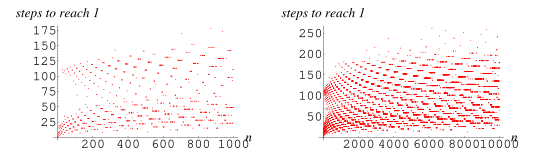
The numbers of steps required for the algorithm to reach 1 for  , 2, ... are 0, 1, 7, 2, 5, 8, 16, 3, 19, 6, 14, 9, 9,
17, 17, 4, 12, 20, 20, 7, ... (OEIS A006577;
illustrated above). Of these, the numbers of tripling steps are 0, 0, 2, 0, 1, 2,
5, 0, 6, ... (OEIS A006667), and the number
of halving steps are 0, 1, 5, 2, 4, 6, 11, 3, 13, ... (OEIS A006666).
The smallest starting values of
, 2, ... are 0, 1, 7, 2, 5, 8, 16, 3, 19, 6, 14, 9, 9,
17, 17, 4, 12, 20, 20, 7, ... (OEIS A006577;
illustrated above). Of these, the numbers of tripling steps are 0, 0, 2, 0, 1, 2,
5, 0, 6, ... (OEIS A006667), and the number
of halving steps are 0, 1, 5, 2, 4, 6, 11, 3, 13, ... (OEIS A006666).
The smallest starting values of  that yields a Collatz sequence containing
  , 2, ... are 1, 2, 3, 3, 3, 6, 7, 3, 9, 3, 7, 12, 7, 9, 15,
3, 7, 18, 19, ... (OEIS A070167).
, 2, ... are 1, 2, 3, 3, 3, 6, 7, 3, 9, 3, 7, 12, 7, 9, 15,
3, 7, 18, 19, ... (OEIS A070167).
The Collatz conjecture can be implemented as an 8-register machine (Wolfram 2002, p. 100), quasi-cellular
automaton (Cloney et al. 1987, Bruschi 2005), or 6-color one-dimensional
quasi-cellular automaton with local rules but which wraps first and last digits around
(Zeleny). In general, the difficulty in constructing true local-rule cellular automata
arises from the necessity of a carry operation when multiplying by 3 which, in the
worst case, can extend the entire length of the base- representation of digits (and thus require propagating information
at faster than the CA's speed of light).
representation of digits (and thus require propagating information
at faster than the CA's speed of light).
The Terras map was introduced by Terras (1976, 1979), who asked if iterating
 |
(2)
|
always reaches 1 for initial positive integer value  (e.g., Lagarias 1985, Cloney et al. 1987). This is simply the original statement
above but combining the division by two into the addition step if
(e.g., Lagarias 1985, Cloney et al. 1987). This is simply the original statement
above but combining the division by two into the addition step if  is odd, thus compressing the number of steps. The following
table gives the sequences for the first few starting values
is odd, thus compressing the number of steps. The following
table gives the sequences for the first few starting values  , 2, ... (OEIS A070168).
 |  , ,  , ,  , ... , ... |
| 1 | 1 |
| 2 | 2, 1 |
| 3 | 3, 5, 8, 4, 2, 1 |
| 4 | 4, 2, 1 |
| 5 | 5, 8, 4, 2, 1 |
| 6 | 6, 3, 5, 8, 4, 2, 1 |
| 7 | 7, 11, 17, 26, 13, 20, 10, 5, 8, 4, 2, 1 |
When the Terras map is extended to all integers, its cycles include (0), (1, 2), ( ), (
), ( ,
,  ,
,  ), and (
 ,
,  ,
,  ,
,  ,
,  ,
,  ,
,  ,
,  ,
,  ,
,  ,
,  ) (Lagarias 1985, p. 13). It is a special case of the
"generalized Collatz problem" with
) (Lagarias 1985, p. 13). It is a special case of the
"generalized Collatz problem" with  ,
,  ,
,  ,
,  , and
, and  .
.
For a positive integer  , let
, let  be its Collatz
stopping time under the Terras map, the least
be its Collatz
stopping time under the Terras map, the least  for which
  , with
  when no such
  exists. This differs from the total time to reach 1. Terras
(1976, 1979) proved that the set
exists. This differs from the total time to reach 1. Terras
(1976, 1979) proved that the set  has a natural
density
has a natural
density  .
If
.
If  counts the positive integers
  with
with  , then the limit
 |
(3)
|
exists. Furthermore,  as
as  , so almost all positive
integers have a finite Collatz stopping time.
Finally, for all
, so almost all positive
integers have a finite Collatz stopping time.
Finally, for all  ,
,
 |
(4)
|
where
 |  |  |
(5)
|
 |  |  |
(6)
|
with  ,
,
 ,
and
,
and  denoting the binary logarithm (Lagarias 1985,
pp. 6 and 9).
denoting the binary logarithm (Lagarias 1985,
pp. 6 and 9).
The Matthews map generalizes this construction to a broader family of piecewise integer iterations, with analogous questions about cycles and divergence.

 Problem 1. Tree-Search Method." Math. Comput. 64, 411-426, 1995.Applegate,
D. and Lagarias, J. C. "Density Bounds for the
Problem 1. Tree-Search Method." Math. Comput. 64, 411-426, 1995.Applegate,
D. and Lagarias, J. C. "Density Bounds for the  Problem 2. Krasikov Inequalities." Math. Comput. 64,
427-438, 1995.Barina, D. "Improved Verification Limit for the Convergence
of the Collatz Conjecture." J. Supercomput. 81, Article 810, 2025.
Problem 2. Krasikov Inequalities." Math. Comput. 64,
427-438, 1995.Barina, D. "Improved Verification Limit for the Convergence
of the Collatz Conjecture." J. Supercomput. 81, Article 810, 2025.
 Map." 26 Feb, 2005.
  Problem: A Quasi Cellular Automaton." Complex Sys. 1,
349-360, 1987.Collatz, L. "On the Motivation and Origin of the
Problem: A Quasi Cellular Automaton." Complex Sys. 1,
349-360, 1987.Collatz, L. "On the Motivation and Origin of the
 -Problem."
In
-Problem."
In  ' Problem." Math. Comput. 32, 1281-1292,
1978.De Mol, L. "Tag Systems and Collatz-Like Functions."
Theor. Comput. Sci. 390, 92-101, 2008.Everett, C. "Iteration
of the Number Theoretic Function
' Problem." Math. Comput. 32, 1281-1292,
1978.De Mol, L. "Tag Systems and Collatz-Like Functions."
Theor. Comput. Sci. 390, 92-101, 2008.Everett, C. "Iteration
of the Number Theoretic Function  ,
,  ." Adv. Math. 25, 42-45, 1977.Guy,
R. K. "Collatz's Sequence." §E16 in
." Adv. Math. 25, 42-45, 1977.Guy,
R. K. "Collatz's Sequence." §E16 in  Problem and Its Generalizations." Amer. Math. Monthly 92,
3-23, 1985.Lagarias, J. C. "The
Problem and Its Generalizations." Amer. Math. Monthly 92,
3-23, 1985.Lagarias, J. C. "The  Problem: An Overview." In
  Search Programs." Comput. Math. Appl. 24,
79-99, 1992.Margenstern, M. and Matiyasevich, Y. "A Binomial Representation
of the
Search Programs." Comput. Math. Appl. 24,
79-99, 1992.Margenstern, M. and Matiyasevich, Y. "A Binomial Representation
of the  Problem." Acta Arith. 91, 367-378, 1999.Numberphile.
"UNCRACKABLE? The Collatz Conjecture." Featuring D. Eisenbud; video
by B. Haran. Aug. 8, 2016.
Problem." Acta Arith. 91, 367-378, 1999.Numberphile.
"UNCRACKABLE? The Collatz Conjecture." Featuring D. Eisenbud; video
by B. Haran. Aug. 8, 2016.  Problem: Computational Results."
Math. Comput. 68, 371-384, 1999.Oliveira e Silva, T. "Computational
Verification of the
Problem: Computational Results."
Math. Comput. 68, 371-384, 1999.Oliveira e Silva, T. "Computational
Verification of the  Conjecture." Sep. 19, 2008.
  Problem." Ch. 7 in
  Problem." Elem. Math. 55, 142-155, 2000.Wolfram,
S.
Problem." Elem. Math. 55, 142-155, 2000.Wolfram,
S.  Zeleny, E. "Collatz Problem as a Cellular
Automaton." 2007.
Zeleny, E. "Collatz Problem as a Cellular
Automaton." 2007.