

The Matthews map is a generalization of the piecewise integer iteration in the Collatz conjecture. Let  be an integer,
let
be an integer,
let  , ...,
  be nonzero integers, and
choose integers
be nonzero integers, and
choose integers  satisfying
  . It is the map
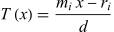 |
(1)
|
when  . The congruence condition
ensures that
. The congruence condition
ensures that  is an integer.
Equivalently, the map can be written
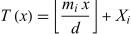 |
(2)
|
when  , where
  , ...,
  are integers and
  is the floor function.
The map is connected with ergodic theory and Markov chains.
is the floor function.
The map is connected with ergodic theory and Markov chains.
The Terras map, which performs the odd Collatz step  and immediately divides the necessarily
even result by 2, is obtained by taking
and immediately divides the necessarily
even result by 2, is obtained by taking  ,
,  ,
,
 ,
,  , and
, and  . Matthews and Watts (1984) studied how the product of
the multipliers
. Matthews and Watts (1984) studied how the product of
the multipliers  affects whether typical trajectories cycle or diverge.
Matthews obtained the following data for the mapping
 |
(3)
|
where  .
.
 | number of cycles | maximum cycle length |
| 0 | 5 | 11 |
| 1 | 10 | 27 |
| 2 | 13 | 34 |
| 3 | 17 | 118 |
| 4 | 19 | 118 |
| 5 | 21 | 165 |
| 6 | 23 | 433 |
Matthews and Watts (1984) proposed the following conjectures for maps of relatively prime type, meaning that 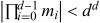 for
for  , ...,
  .
.
1. If 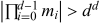 ,
then all trajectories
,
then all trajectories  for
for  eventually cycle.
2. If  ,
then almost all trajectories
,
then almost all trajectories  for
for  are divergent, except for an exceptional set
  of integers satisfying
 |
(4)
|
3. The number of cycles is finite.
4. If the trajectory  for
for  is not eventually cyclic, then
the iterates are uniformly distributed modulo
is not eventually cyclic, then
the iterates are uniformly distributed modulo  for each
  , with
 |
(5)
|
for  .
.
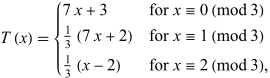
Matthews conjectured that the map
 |
(6)
|
either reaches a multiple of 3 or enters one of the cycles  or
or  , and offered a $100 prize for a proof (Matthews).

 Mapping."
  Conjecture." [$100 Reward for a Proof.]