


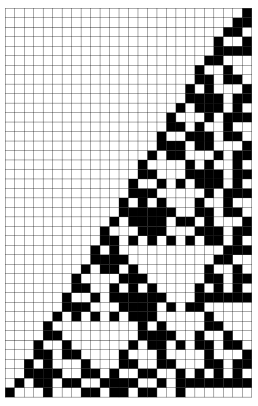
The name Wolfram sequences is used here for the following integer sequences considered by Wolfram (2002, pp. 123 and 129). The first is related to the Collatz conjecture and is obtained by iterating
 |
(1)
|
starting with  .
This gives the sequence 1, 3, 6, 9, 15, 24, 36, 54, 81, 123, ... (OEIS A070885).
The first 40 iterations are illustrated above, with each row being one iteration
and the number obtained in that iteration represented in binary.
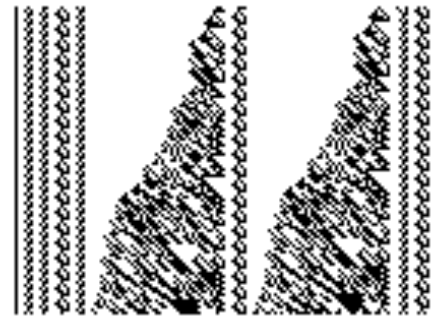
Another set of sequences are given by
 |
(2)
|
starting with various positive integer initial values  .
The starting values
 ,
2, 3, 4, 5, 7, 9, 10 give eventually periodic sequences. The displayed 100 iterations for
 and 8 show more complicated behavior. Wolfram (2002, pp. 123-124)
reports no repetition even after a million steps starting at 6. The first 100 iterations
starting at each of
 to 10 are illustrated above.
The following three recurrence relations apply for integers  . Wolfram also considered the sequence 1, 1, 3, 3, 3,
5, 3, ... (OEIS A070864) defined by
 and
 |
(3)
|
(Wolfram 2002, p. 129, (b)), the sequence 1, 1, 2, 2, 2, 4, 3, 4, 4, 4, ... (OEIS A070867)
defined by  and
 |
(4)
|
(Wolfram 2002, p. 129, (f)), and the sequence 1, 1, 2, 2, 2, 3, 3, 4, 3, 4, ... (OEIS A070868)
defined by  and
 |
(5)
|
(Wolfram 2002, p. 129, (h)).
